
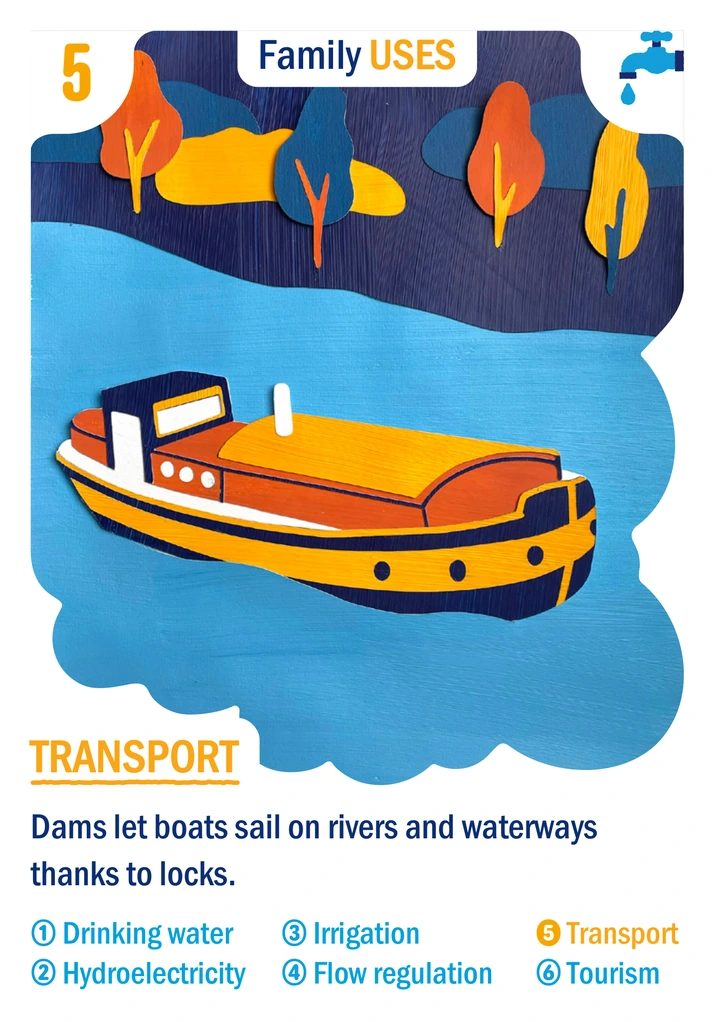
Uses family · card no. 5
Transport
Thanks to dams and locks, boats can sail on rivers and big rivers.
Educational fact sheet
In brief
A wild river has strong currents and places too shallow for boats. Dams and canals turn it into a motorway on water, where barges carry huge loads while using little energy.
How does it work?
- Dams create steps of calm water, like a staircase, called reaches (biefs).
- To go from one step to the next, the boat enters a lock: a big box with a gate at each end. The gates are closed, the box is filled or emptied, and the boat goes up or down like in an elevator.
- The Rhine, the Rhône and the Seine link ports to big cities and factories in this way.
Key facts
A large convoy of 4,400 tonnes carries as much as 220 trucks. For the same tonne carried over one kilometer, a boat generally emits less CO₂ (the gas that warms the planet) than a truck.
Words to know
- Lock: a boat elevator that works with water.
- Barge: a long flat boat that carries goods.
Did you know? At the Three Gorges dam, in China, a real boat elevator lifts ships of 3,000 tonnes by 113 meters (almost as high as a 35-story building), in under 40 minutes.
Going further
- The CO₂ balance depends on the boat, the load, the fuel and the trip: we say it is "generally favorable" per tonne-kilometer, without boiling it down to a single figure.
In FrenchTransport