
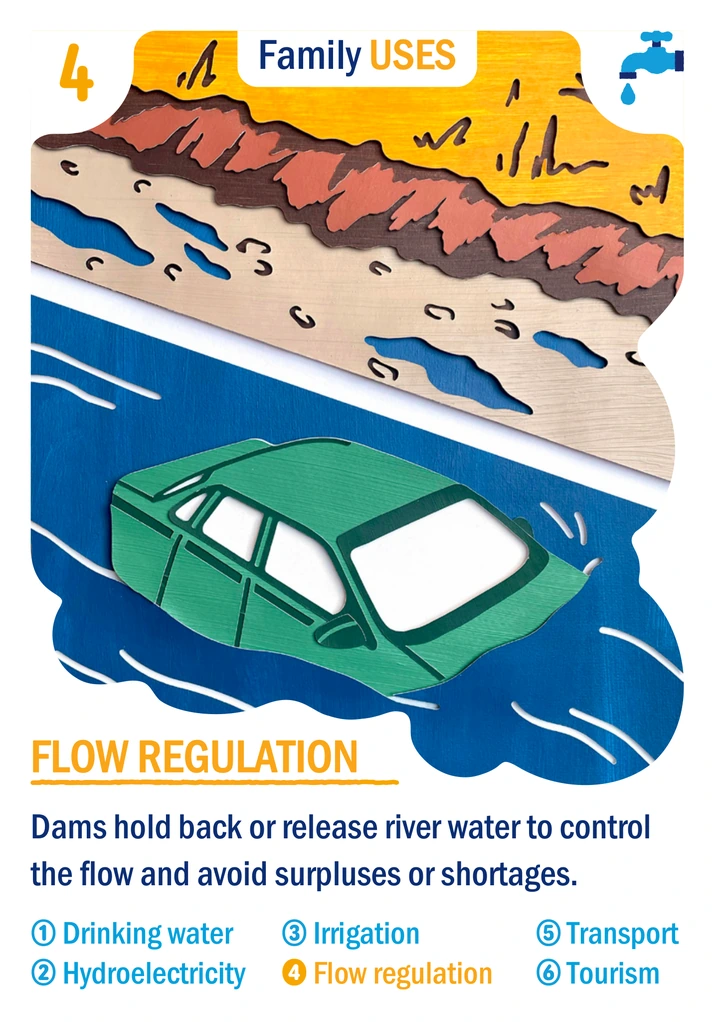
Uses family · card no. 4
Flow regulation
The dam keeps or releases water to prevent floods and to stop the river from running dry.
Educational fact sheet
In brief
The flow is the amount of water passing in the river. It is never quite the same: sometimes the river overflows, sometimes it is almost dry. The dam acts as a giant tap to calm all that down.
How does it work?
It has two missions:
- Reduce floods. When it rains very hard, some dams keep part of the lake empty, like a big bathtub. They store the extra water there, then release it very gently. Towns downstream are better protected, even though the risk never disappears.
- Help the river in summer. When the river lacks water (this is called low-water period, or étiage), the dam releases a little water continuously. Fish survive, factories keep running and power plants stay cooled.
Key facts
The 4 big reservoir lakes upstream of Paris can hold 810 million cubic meters of water, enough to fill 320,000 Olympic swimming pools, to reduce some floods of the Seine and support its flow in summer.
Words to know
- Flood: a river that swells and risks overflowing.
- Low water (étiage): the period when the river is at its lowest.
Did you know? During very dry summers, like in 2022, the Naussac and Villerest dams release water to help the Loire keep flowing. In some stretches, this supply can be a significant part of its flow.
Going further
To reduce a flood, a dam must have free space in its reservoir before the water arrives: a lake that is already full can no longer store anything. That is why some dams keep part of their volume empty, or lower their level a little when heavy rain is forecast. Even so, a dam reduces the risk of flooding without ever removing it.
In FrenchRégulation du débit