
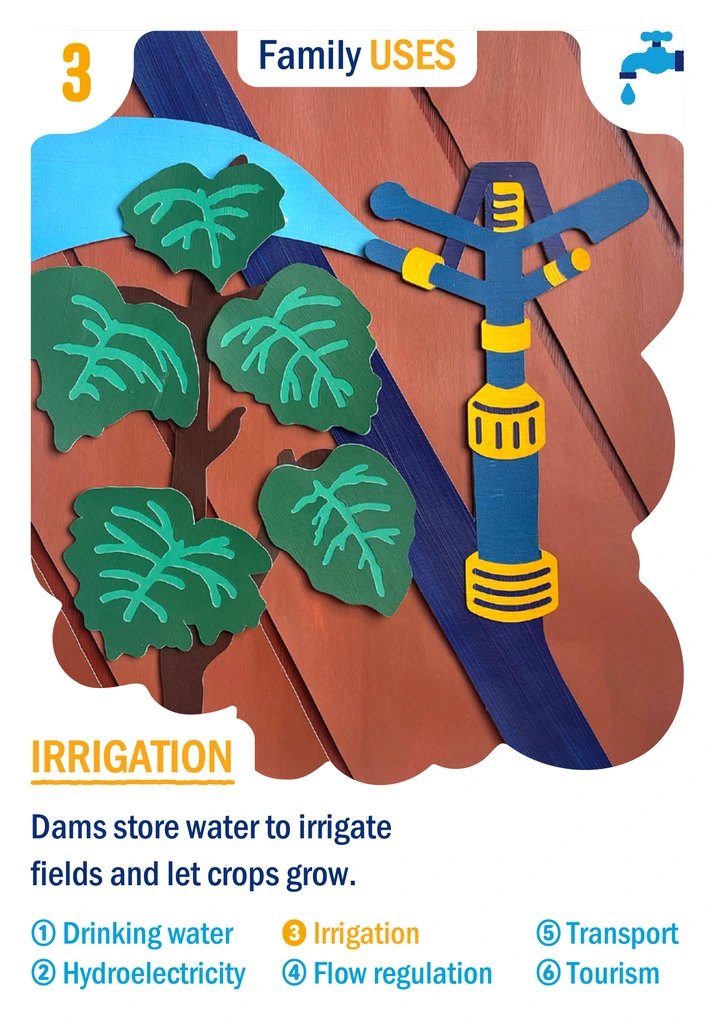
Uses family · card no. 3
Irrigation
Dams keep water to water the fields and let plants grow, even in summer.
Educational fact sheet
In brief
Without water, plants do not grow! Irrigation means bringing water to fields, orchards and vegetable gardens. Dams set aside the water of winter rain and snow, to give it to crops in summer.
How does it work?
- Water is released into the river, or sent through canals and pipes to the fields.
- It arrives in clever watering systems, like drip irrigation, which can cut water losses when well installed and well adjusted.
- Thanks to these reserves, we do not need to pump too much from rivers and underground water (the water hidden in the soil) when they are almost dry.
Key facts
- Worldwide, agriculture makes up about 70% of the fresh water taken (7 liters out of 10).
- In France, canals and reservoirs bring water to a great many hectares of crops.
Words to know
- Crop: plants we grow in order to harvest them.
- Aquifer (water table): a reserve of water hidden under the ground.
Did you know? The Serre-Ponçon lake makes it possible to water more than 150,000 hectares in Provence. Thanks to it, fruit and vegetables grow there even when it hardly rains!
Going further
Not all the water taken to water a field is "consumed". Some is drunk by the plants or evaporates into the air, while some goes back to the river or soaks into the ground to reach the aquifers. Specialists therefore tell apart the water that is withdrawn (the water we go and get) from the water that is truly consumed (the water that does not come back).
In FrenchIrrigation