
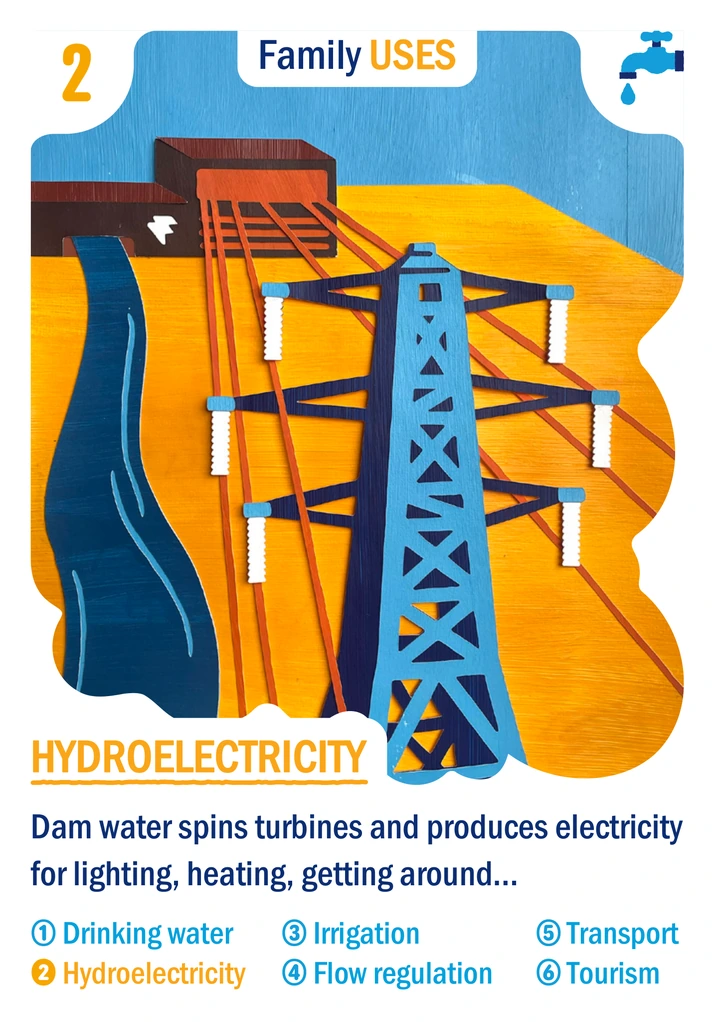
Uses family · card no. 2
Hydroelectricity
The dam's water turns turbines that make electricity, to light our homes, heat them and power our travel.
Educational fact sheet
In brief
The word is long, but the idea is simple: "hydro" means water. Hydroelectricity is electricity made with falling water. It is the world's first renewable source of electricity (an energy that never runs out).
How does it work?
Imagine a giant slide:
- Water is stored up high, in the lake.
- It rushes down big steel pipes, the penstocks, faster and faster.
- It hits the blades of a turbine, a kind of big mill, which starts to spin.
- The turbine turns a generator, which makes electricity, sent along wires to our homes.
Key facts
- Some lake power plants or pumped-storage stations can start very quickly, in just a few minutes!
- In France, hydropower provides about 1 electricity in 10 (11.4% in 2025) and gives off very few of the gases that warm the planet.
Words to know
- Renewable: something that renews itself (water comes back with the rain).
- Turbine: a wheel with blades that a fluid makes spin.
Did you know? When everyone switches on the light in the evening, or when the sun sets and solar panels stop, hydro plants can raise their output very fast: they help keep the electric grid balanced.
Going further
A hydroelectric plant burns no fuel: it only uses falling water, so it gives off very few greenhouse gases while it runs. But building a dam takes a lot of concrete, steel and work, which leaves a footprint on the environment. That is why electricity sources are compared over their whole life, from construction to the end of the structure.
In FrenchHydroélectricité