
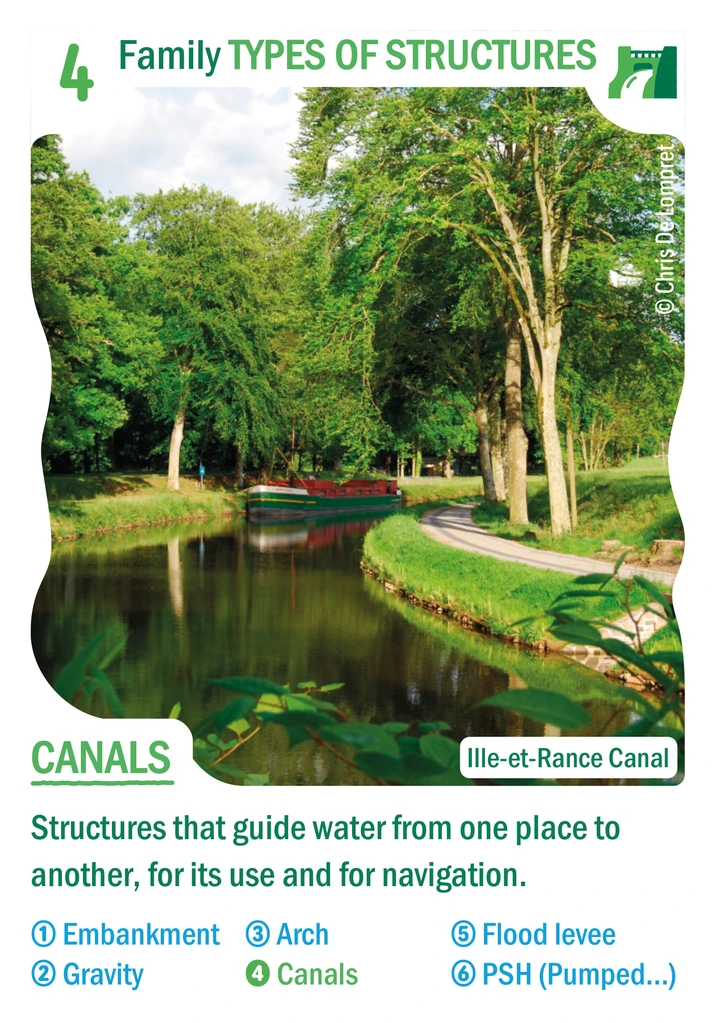
Types of structures family · card no. 4 · Ille-et-Rance Canal
Canals
Rivers dug by humans to bring water from one place to another and let boats sail.
Educational fact sheet
In brief
A canal is a river made by humans. It is dug across plains and hills to carry goods, bring water to towns or irrigate fields.
How does it work?
A river runs downhill on its own. A canal, on the other hand, is more like a staircase of flat stretches of water:
- The reach (bief): a very watertight stretch, where the water stays calm and at a constant level, so that barges move without fighting a current.
- The locks: to climb a hill, boats go from lock to lock, like in an elevator.
- The canal bridges: to cross a river or a valley, a bridge is built that carries a canal! The most famous in France is the one at Briare, above the Loire.
Key facts
- Ille-et-Rance Canal (Brittany): 85 km and 48 locks between Rennes and Saint-Malo, opened in 1832.
- France has about 8,500 km of navigable waterways (canals and improved rivers), one of the longest networks in Europe.
Words to know
- Reach (bief): a section of canal between two locks.
- Barge: a long, flat boat for carrying goods.
Did you know? The highest point of a canal (the summit reach) is tricky to feed with water, because each lockage lets water flow down. It is supplied with reservoirs, channels or pumps, otherwise the canal would dry up!
Going further
Every passage through a lock uses water: like filling a big box, all the water needed to lift a boat then flows away downstream. So the canal must be fed all the time, especially at its highest point. Some locks have water-saving basins, neighboring reservoirs that recover part of this water to give it back to the next passage.
In FrenchCanaux
Photo credit : © Chris De Lompret