
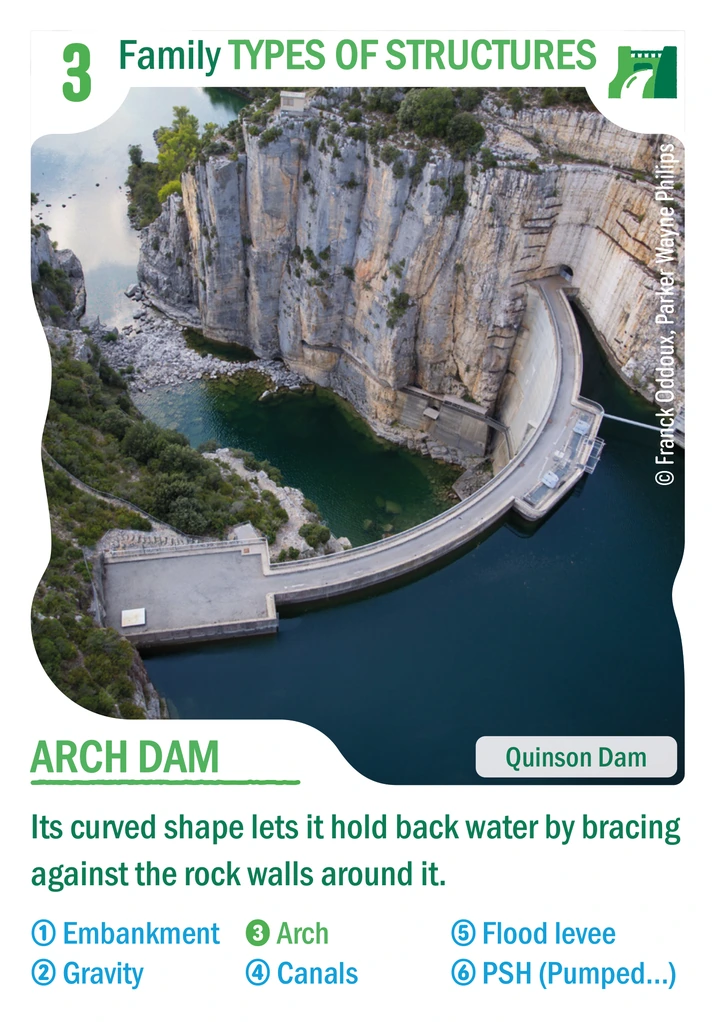
Types of structures family · card no. 3 · Quinson dam
Arch dam
Its curved shape lets it hold back water by leaning on the cliffs on each side.
Educational fact sheet
In brief
The arch dam is a dam that is curved toward the lake, like an arch. It does not hold mainly through its weight, but by passing the push of the water on to the cliffs on each side of the valley.
How does it work?
It is the same principle as the arches of old bridges or churches, but laid down horizontally:
- The water pushes on the curved wall, which squeezes itself together instead of bending.
- Concrete loves being squeezed! The force follows the curve and leans on the rock on both sides: these supports are called abutments.
- Modern arches are also curved from top to bottom (double curvature), like the hull of a boat, which makes them very thin.
Key facts
- An arch dam can use far less concrete than a comparable gravity dam.
- Quinson (Verdon): a pretty arch 45 meters high.
Words to know
- Arch (voûte): a curved shape, like a bow.
- Abutment: a support of rock or concrete that receives the push.
Did you know? When the lake fills, the water pushes harder and the arch squeezes more tightly against its supports. Engineers calculate these forces and deformations for every water level.
Going further
An arch uses little concrete, but in exchange it needs a fairly narrow valley and very solid rock supports, because all the push of the water ends up in the cliffs. That is why it is built mostly in gorges. In a wide valley, an embankment dam or a gravity dam is often better suited.
In FrenchBarrage voûte
Photo credit : © Franck Oddoux, Parker Wayne Philips