
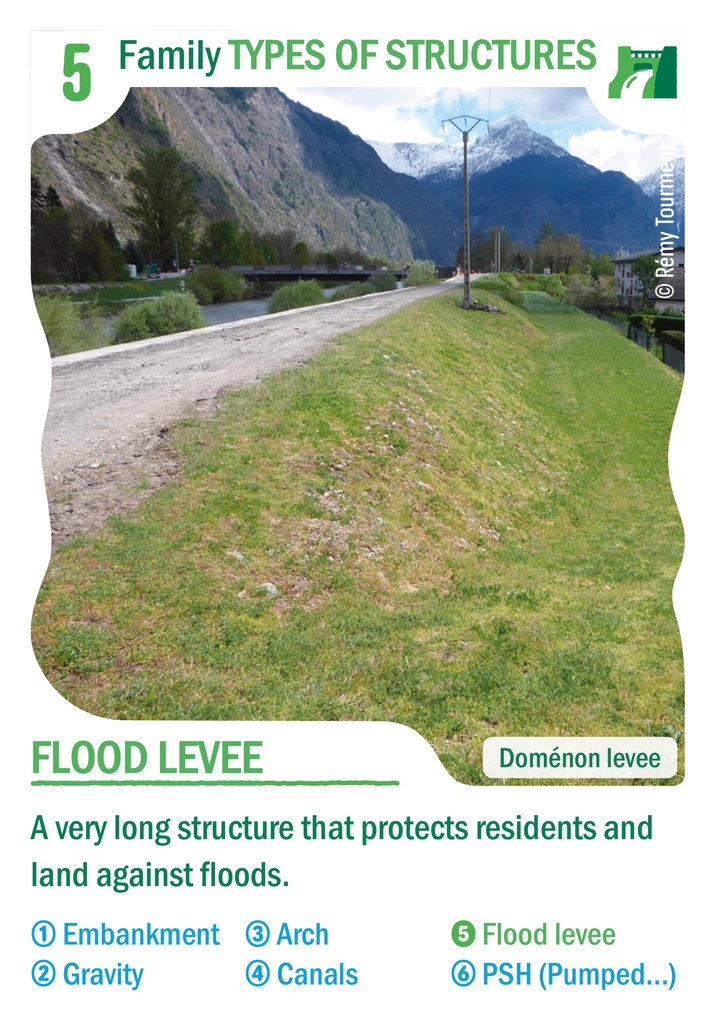
Types of structures family · card no. 5 · Doménon levee
Flood protection levee
A long structure that protects residents and land against floods.
Educational fact sheet
In brief
A dam blocks a river to make a lake. A levee, instead, is a long wall that runs along the river or the sea, sometimes for kilometers, to stop water from flooding towns and fields.
How does it work?
- When all is well: the levee is dry, or the water barely touches its foot.
- When there is a flood: the water rises, and the levee keeps it in its bed.
- The risks being watched:
- overtopping: water goes over the top and gnaws at the levee from behind;
- piping (the "hydraulic fox"): water slips under the levee and carries away sand, like a small tunnel that keeps getting bigger;
- sliding: the levee, soaked with water, loses strength and slides.
- A trick: sometimes a deliberately lower spot is planned where water can spill over toward fields, to protect the houses.
Key facts
In France, thousands of kilometers of levees protect millions of people, along the Loire, the Rhône, the Seine and the coast.
Words to know
- Flood (inundation): when water covers land that is normally dry.
- Levee (digue): a long wall or bank that holds back water.
Did you know? The burrows of coypus, badgers or foxes can weaken a levee. That is why workers walk along it regularly, especially after a flood, to spot and fill in these holes.
Going further
A levee reduces a risk but does not remove it: it is designed to protect up to a certain level of flood. If a bigger flood arrives, the water can go over the top or the levee can fail. That is why we avoid building right behind a levee, and why residents of protected areas must stay informed about the risks.
In FrenchDigue de protection
Photo credit : © Rémy Tourment