
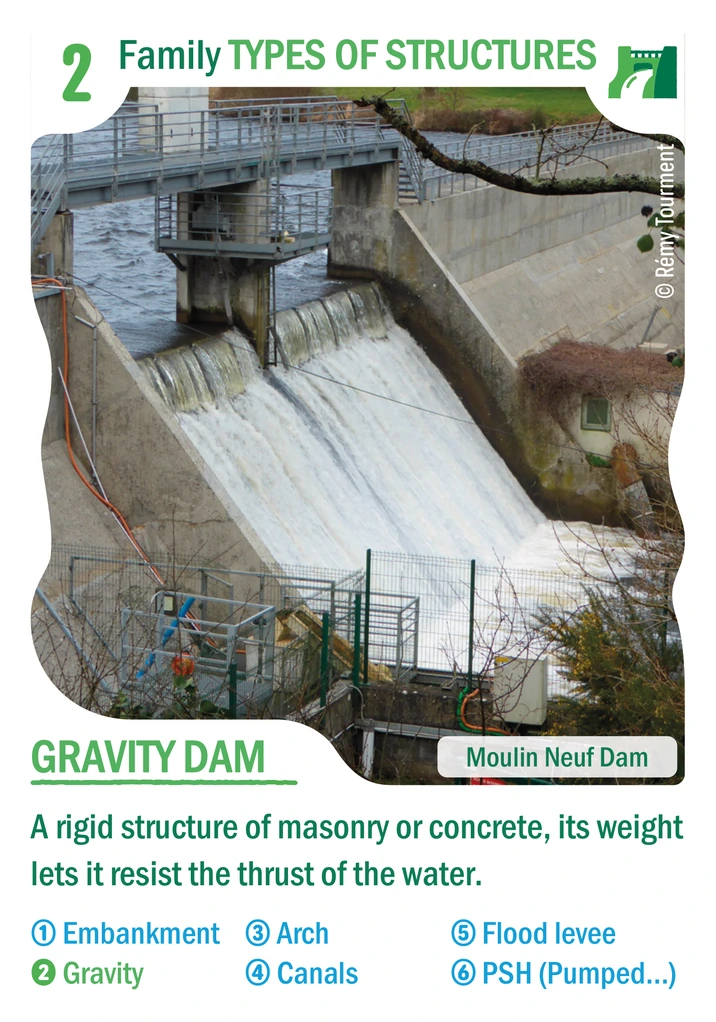
Types of structures family · card no. 2 · Moulin Neuf dam
Gravity dam
A wall of concrete or stone: its enormous weight keeps it from being pushed by the water.
Educational fact sheet
In brief
The gravity dam is the champion of brute force. It is a wall of concrete or stone so heavy that it holds mainly through its weight, helped by its foundation, without sliding or tipping under the push of the water.
How does it work?
Think of a big block of stone at the edge of a table: to push it, you need a lot of force!
- The water pushes the dam downstream.
- Its weight presses it to the ground, with an even bigger force.
- Result: it stays in place. Its shape, wide at the bottom and narrower at the top, looks like a right triangle: the lake side is almost straight, the downstream side is sloped.
Key facts
The tallest gravity dam in the world is the Grande Dixence (Switzerland): 285 meters high, with 15 million tonnes of concrete.
Words to know
- Masonry: construction with stones joined with mortar.
- RCC (roller-compacted concrete): almost dry concrete, spread by bulldozers and crushed by rollers.
Did you know? Today, many gravity dams are made of roller-compacted concrete: it is spread like soil, then packed down. It makes building much faster!
Going further
In a gravity dam, the foundation and the drainage are almost as important as the weight of the concrete. If water seeps under the dam, it lifts it a little and reduces the friction that holds it on the ground. So drains are drilled under the structure, and the water pressure is monitored to make sure it stays low.
In FrenchBarrage poids
Photo credit : © Rémy Tourment