
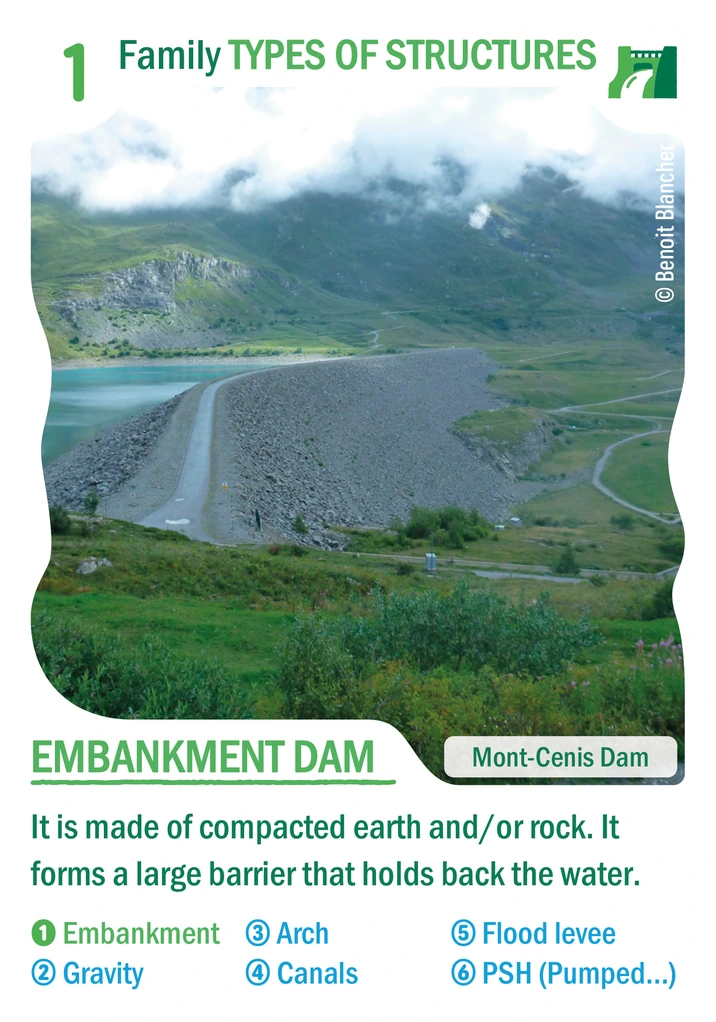
Types of structures family · card no. 1 · Mont-Cenis dam
Embankment dam
It is made of packed earth and rock: a big "hill" that holds back the water.
Educational fact sheet
In brief
The embankment dam looks like a mountain built by humans. It is made of piled-up earth or stones, with gentle slopes. It is the most common type of dam in the world, because it fits almost every valley.
How does it work?
Instead of a straight wall, it has the shape of a big spread-out triangle:
- The "shoulders": millions of tonnes of rocks and gravel, which give the dam its weight and stability.
- Watertightness: since rocks let water through, a barrier is needed. Either a clay core (a sticky soil) in the middle, or a concrete or bitumen facing on the lake side.
- The filters: layers of graded sand stop the water from carrying the soil away.
Key facts
- It is the family of dams that is the most widespread in the world.
- Mont-Cenis (Savoie): 120 meters high, and a lake at 2,000 m altitude.
Words to know
- Embankment (remblai): a pile of earth or rocks packed down to form a wall or a hill.
- Crest: the top of the dam.
Did you know? For a standard embankment dam, water passing over the top (called overtopping) is a major risk: it can tear the soil away in a few minutes. That is why a well-sized spillway is planned.
Going further
In an earth dam, a little water always ends up getting through: what matters is that it does not carry the soil with it. The filters, layers of sorted sand and gravel, let the water through but hold back the grains of soil; the drains collect this water and send it downstream. Without good filters, a tiny passage could widen from the inside.
In FrenchBarrage en remblai
Photo credit : © Benoit Blancher