
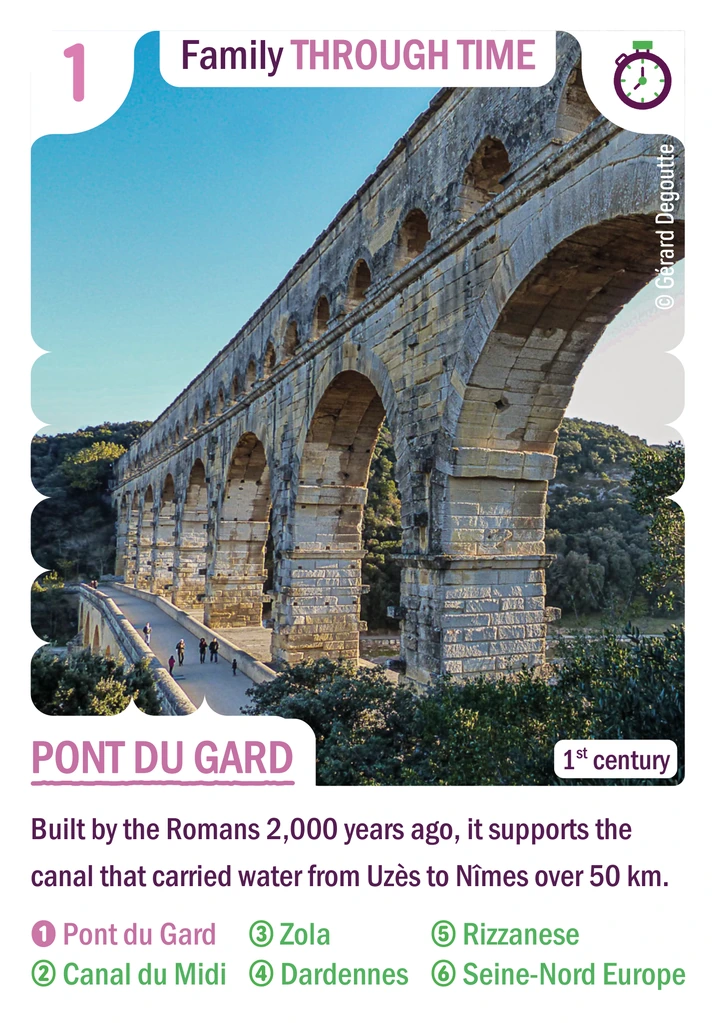
Through time family · card no. 1 · Occitanie (Gard)
Pont du Gard
Built by the Romans 2,000 years ago, it carried the canal that brought water from Uzès to Nîmes over 50 km.
Educational fact sheet
In brief
The Pont du Gard is 2,000 years old! Built by the Romans, it is the tallest Roman aqueduct bridge in the world. An aqueduct is a structure that carries water, sometimes over tens of kilometers. The Pont du Gard is the part that crosses the river: a bridge-aqueduct. It is listed by UNESCO, the list of treasures to protect for all humans.
How does it work?
It was not a bridge for cars or carts, but a piece of a long 50-km canal that brought water to the Roman city of Nîmes:
- It crosses the Gardon River to bring water from the Eure spring, near Uzès, to the fountains, baths and homes of Nîmes.
- Three levels of arches: 6 on the first level, 11 on the second, 35 at the very top, which carry the canal.
- An ultra-precise slope: over 50 km, the water drops only 12.6 meters in all. There is no pump: the water flows by itself, very gently, as on a very slight slope!
Key facts
- Height: 48.77 m. Length: 275 m for the preserved upper part (it was longer originally).
- Built in the 1st century, with stone blocks largely laid dry, without mortar; the upper channel was covered with a coating.
- Listed by UNESCO in 1985.
Words to know
- Aqueduct: a structure that carries water.
- Mortar: a mix that glues stones together.
Did you know? The inside of the channel was covered with a red coating made of lime and crushed tiles to make it watertight. Two thousand years later, you can still see it on the walls!
Going further
- The bridge-aqueduct is part of the Nîmes aqueduct, about 50 km long.
- The masonry is largely assembled dry, but the channel and some elements include mortars and coatings.
In FrenchPont du Gard
Photo credit : © Gérard Degoutte