
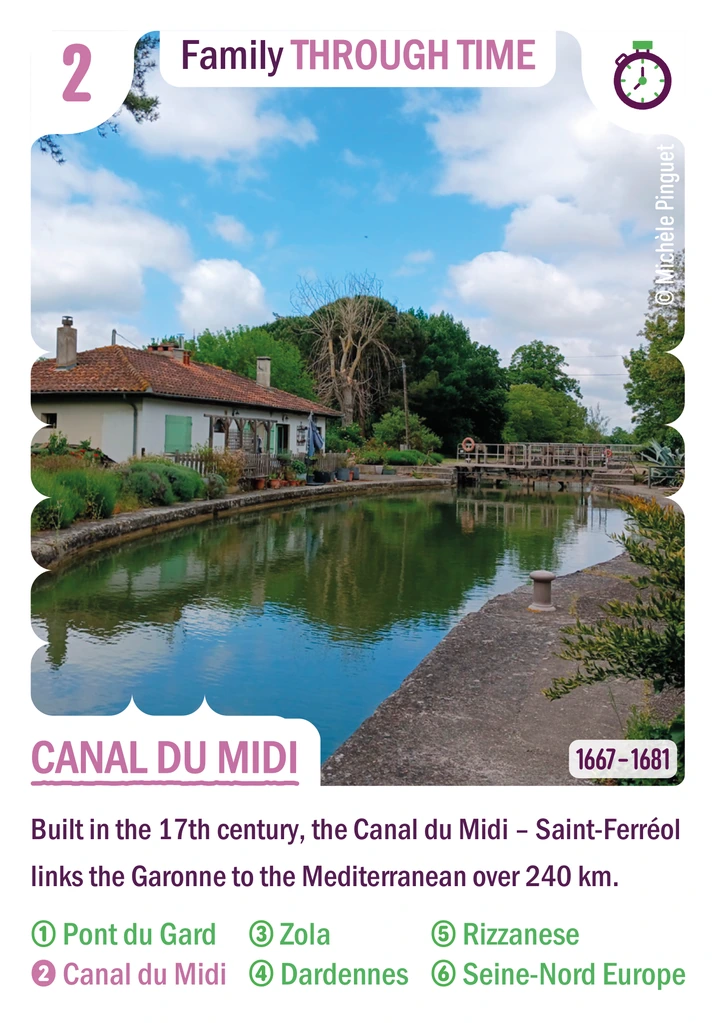
Through time family · card no. 2 · Occitanie
Canal du Midi
Built in the 17th century, it links the Garonne to the Mediterranean over 240 km, thanks to the Saint-Ferréol lake.
Educational fact sheet
In brief
The Canal du Midi links Toulouse to the Mediterranean Sea over 240 kilometers. It was imagined by Pierre-Paul Riquet in the time of Louis XIV. Its secret: a big reservoir lake, Saint-Ferréol, held back by one of the oldest large dams still in service in France.
How does it work?
Since Antiquity, people had dreamed of linking the Atlantic to the Mediterranean without going around Spain. But there was a big problem: how to feed with water the highest point of the canal (at 189 m altitude) in the middle of summer?
- Riquet had the idea of collecting the water of the streams of the Montagne Noire and storing it in a big lake, Saint-Ferréol, closed by a 780-meter dam.
- When the canal runs short of water in summer, the gates are opened: the water goes down a channel (a small canal, a rigole) to the high point.
- Later, Vauban, a famous military engineer, inspected and strengthened the structure.
Key facts
- The main canal is 240 km long and has 65 locks, including the famous staircase locks of Fonséranes, at Béziers.
- Saint-Ferréol: 780 m long, 32 m high.
- Listed by UNESCO in 1996.
Words to know
- Rigole: a small canal that brings water.
- Summit (seuil): the highest point where two slopes meet.
Did you know? Pierre-Paul Riquet spent all his fortune and his health on his canal. He died in 1680, a few months before the canal opened: he never saw it finished!
Going further
Saint-Ferréol does not fill up on its own. A network of channels, dug on the slopes of the Montagne Noire, collects the water of several streams and leads it to the lake. Another channel then brings the water to the highest point of the canal.
In FrenchCanal du Midi
Photo credit : © Michèle Pinguet