
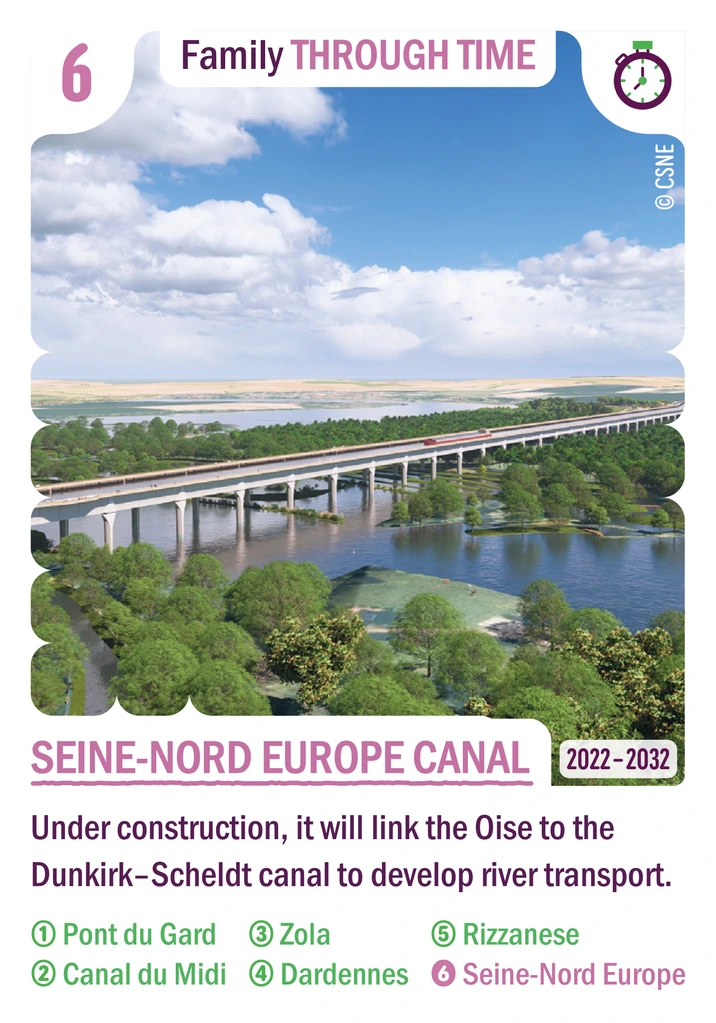
Through time family · card no. 6 · Hauts-de-France
Seine-Nord Europe Canal
Under construction, it will link the Oise to the Dunkirk-Scheldt canal so that more boats can travel.
Educational fact sheet
In brief
The Seine-Nord Europe canal is a very large waterway project of this century in Europe. 107 kilometers long, it will link Compiègne to the Dunkirk-Scheldt canal, and connect France to 20,000 km of waterways in northern Europe.
How does it work?
It is a big project full of modern ideas:
- A big canal: 54 m wide and 4.5 m deep, for convoys of 4,400 tonnes.
- 6 big locks with "water-saving basins" (plus a junction lock with the Canal du Nord): these basins recover a large part of the water at each boat passage, up to about 70%, so as not to drain the neighboring rivers.
- A reservoir lake: at Louette, it will hold 14 million cubic meters of water to feed the canal, even during a heatwave.
Key facts
- Length: 107 km.
- Each big convoy will replace 220 trucks on the A1 motorway.
- Work started in 2022, entry into service planned for 2032.
Words to know
- Water-saving basin: a reservoir used to save the water of a lock.
- Large-gauge canal: said of a canal big enough for large boats.
Did you know? The canal will pass over the Somme valley on a 1.3 km canal bridge, perched on pillars: animals and rivers will be able to keep passing underneath.
Going further
The principle of the water-saving basins is simple. When a boat goes down, part of the lock's water first flows into big neighboring basins, with no pump at all, simply thanks to the slope. When a boat goes up, this water is given back to the lock. The water still missing is replaced by pumping.
In FrenchCanal Seine Nord Europe
Photo credit : © CSNE