
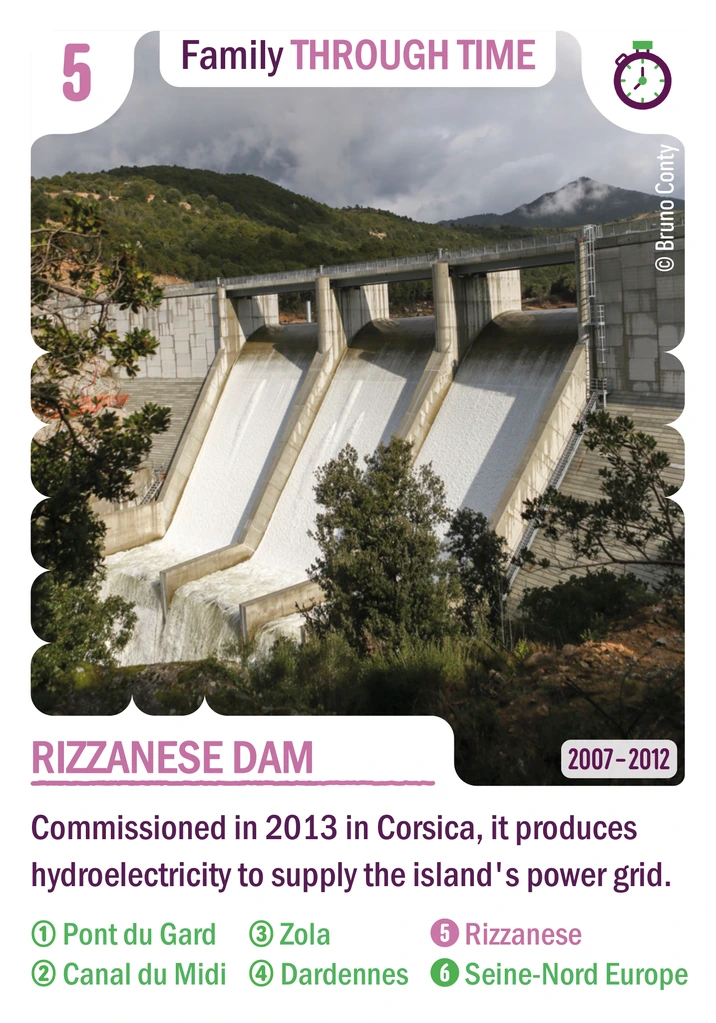
Through time family · card no. 5 · Corse-du-Sud (Levie / Sorbollano)
Rizzanese Dam
Commissioned in 2013 in Corsica, it produces electricity for the whole island's grid.
Educational fact sheet
In brief
Inaugurated in 2013 in Corse-du-Sud, the Rizzanese dam is the most powerful hydroelectric facility in Corsica. It is one of the last large dams built in France.
How does it work?
It is a very modern gravity dam, made of roller-compacted concrete (RCC): an almost dry concrete, spread in layers and crushed by rollers:
- This technique makes it possible to build very fast.
- The water, held at 530 m altitude, crosses the mountain in a 5.7 km tunnel, then rushes down a pipe to the Sainte-Lucie-de-Tallano power plant.
- Corsica is an island: its electricity grid is not directly connected to that of mainland France, but it has links with Italy and Sardinia. The Rizzanese turbines, which start very fast, help balance the grid morning and evening, when everyone uses a lot of electricity.
Key facts
- Height: 40.5 m. Length: 140 m.
- Power: 55 MW, or about 80 million kWh per year.
- It increased by about 40% Corsica's hydropower production capacity.
Words to know
- Electricity grid: all the wires and power plants that deliver electricity everywhere.
- Power and energy: power (in MW) is measured at one moment; energy produced (in kWh) is measured over a period of time.
Did you know? The construction took measures to protect Corsica's native trout, with a guaranteed minimum flow of water in the river.
Going further
On an island, the electricity grid is small and not well connected to others: at every moment, the amount of electricity produced must equal the amount used, otherwise the grid goes out of balance. A hydropower plant can change its output within minutes. It is therefore valuable to make up for an evening peak in demand, or a cloud that makes solar panel output drop.
In FrenchBarrage du Rizzanese
Photo credit : © Bruno Conty