
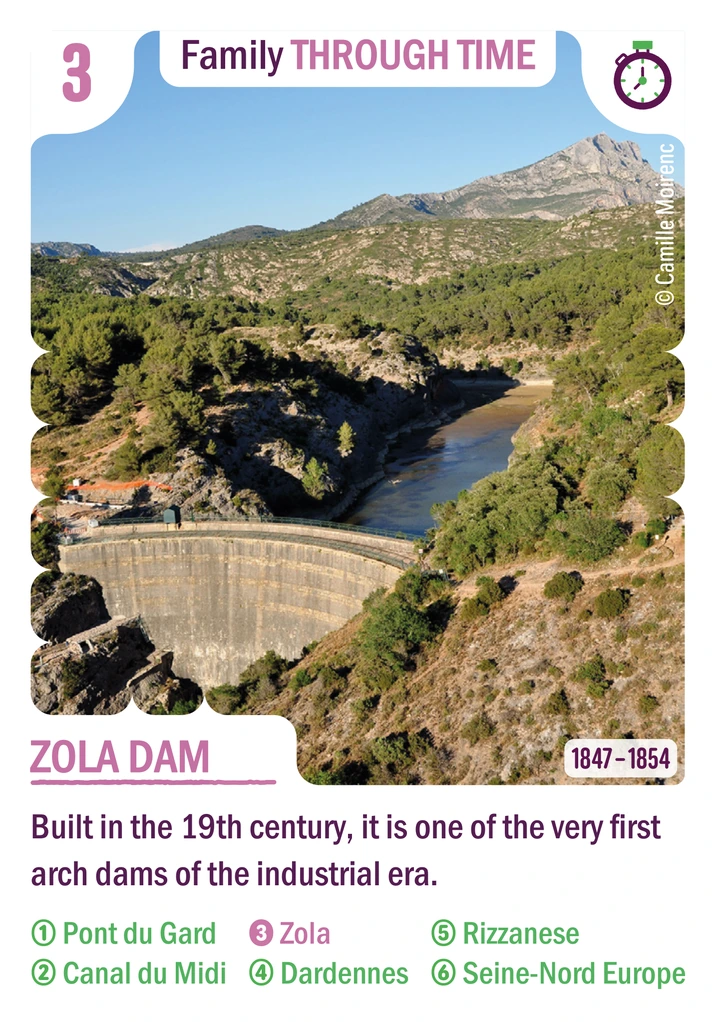
Through time family · card no. 3 · Le Tholonet (Aix-en-Provence)
Zola Dam
Built in the 19th century, it is one of the very first scientifically calculated arch dams.
Educational fact sheet
In brief
At the foot of Mont Sainte-Victoire, near Aix-en-Provence, the Zola dam is a monument in the history of dams. It was designed by the engineer François Zola, the father of the writer Émile Zola. It is one of the first arch dams calculated with mathematics.
How does it work?
In a time marked by cholera epidemics (a serious disease caused by dirty water), Aix needed cleaner and more plentiful water. François Zola proposed a dam:
- Instead of a very heavy stone wall, he calculated the shape of a stone arch, turned toward the lake.
- The push of the water is sent onto the two rocky banks of the gorge.
- François Zola died during the work, in 1847, but his plans were followed to the letter until the inauguration, in 1854.
Key facts
- Height: 36.5 m. Length: 66 m.
- The Zola canal was Aix's main water source until 1877; after that, the Verdon canal took over.
Words to know
- Cholera: a serious disease spread by dirty water.
- Strength of materials: the science that calculates what a stone or a concrete can bear.
Did you know? When he was a child, Émile Zola walked near his father's dam with his friend Paul Cézanne, who would become a great painter. They swam there, and Cézanne even painted the dam!
Going further
At that time, people mostly built thick, heavy walls, relying on experience. François Zola, instead, used calculation to find the shape of an arch that sends the push of the water toward the rocky banks. Today, engineers follow the same reasoning with computers.
In FrenchBarrage Zola
Photo credit : © Camille Moirenc