
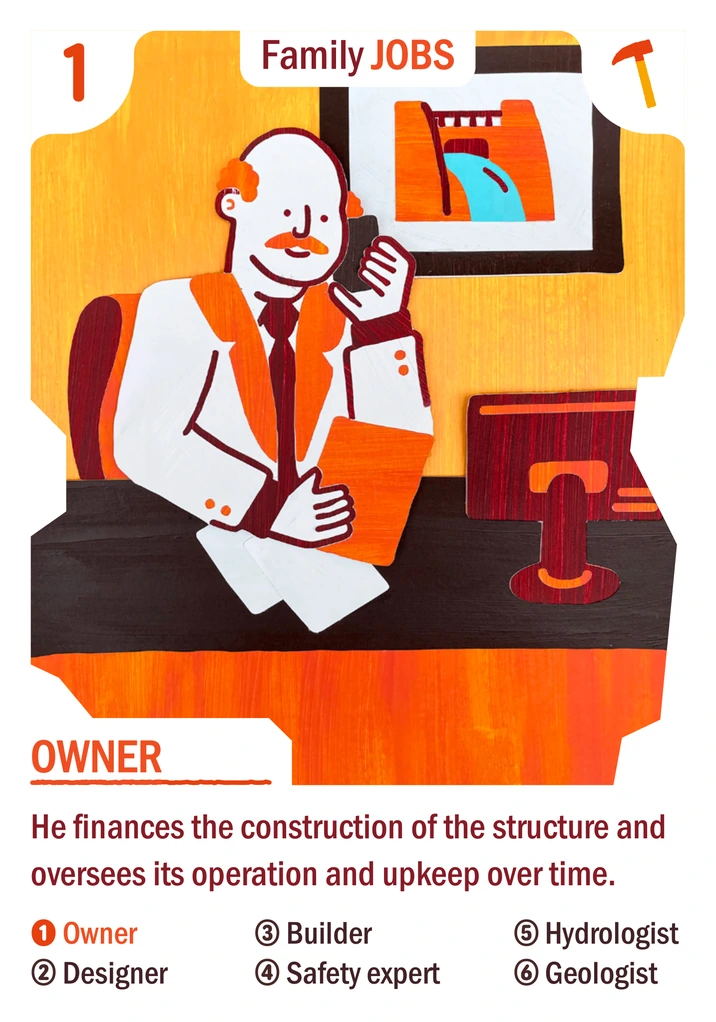
Jobs family · card no. 1
Owner
The owner pays for the dam to be built, then looks after it for its whole life: upkeep, monitoring, safety.
Educational fact sheet
In brief
The owner is the dam's guardian. Just like the owner of a house, they pay to keep it standing and in good shape. Except that their "house" holds back millions of liters of water!
How does it work?
In France, many large dams belong to the State. It hands over their operation to a company through a contract called a concession (EDF, for example, produces electricity with them). Dams that supply tap water or water fields mostly belong to towns or groups of municipalities.
The owner must:
- pay for monitoring and repairs, year after year;
- imagine the worst: for the most important dams, they write and update a danger study (what would happen in a huge flood, when the river overflows, or in an earthquake?);
- work with the State, which checks that everything is safe for the people living downstream, that is, further down the valley.
Key facts
- Dams are ranked A, B or C depending on their height and the volume of water they hold (for small structures, what lies downstream also counts).
- Class A is the most closely controlled: it starts at 20 meters high (a 7-story building), but height is not the only criterion.
Words to know
- Concession: a contract by which the State entrusts a company with building or running a hydroelectric facility, for a limited time.
- Operator: the one who runs the dam day to day (sometimes the owner, sometimes a concession company).
- Downstream: the side of the dam where the river carries on its way.
Did you know? The biggest dams have an alert plan for local residents, with sirens tested regularly, so that everyone is ready if one day an evacuation were needed.
Going further
In France, dams are ranked A, B or C mainly according to their height and the amount of water they hold. The dams in the most important classes get more thorough checks and studies. Some very large facilities also have a special emergency plan (called a PPI) that organizes the alert and the protection of residents in case of an accident.
In FrenchPropriétaire