
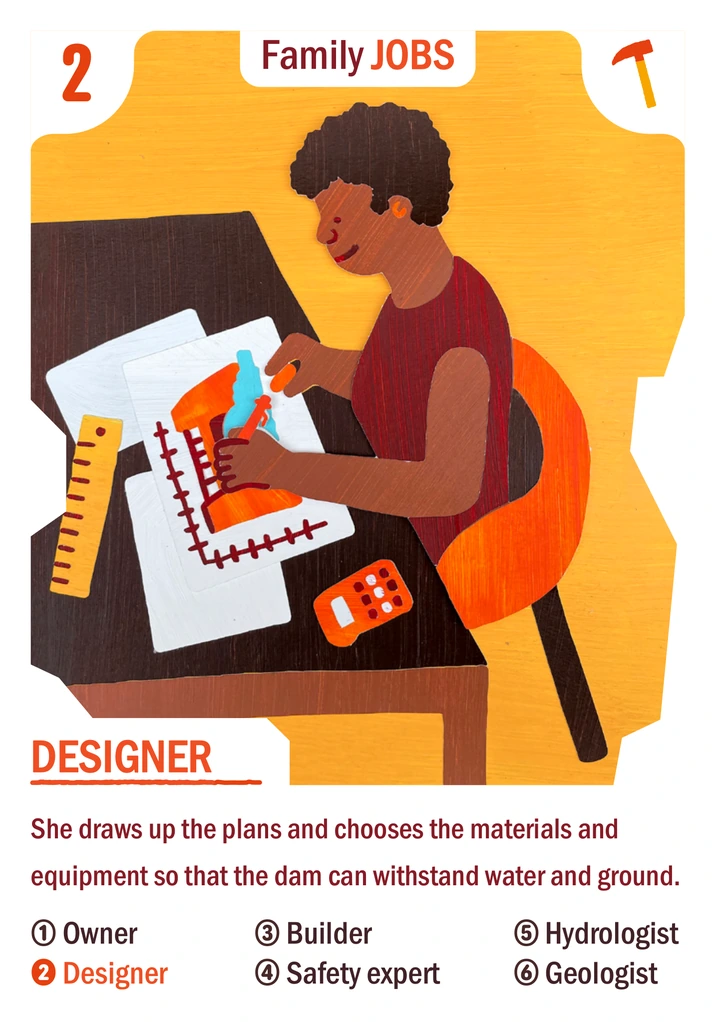
Jobs family · card no. 2
Designer
She invents the shape of the dam and does all the calculations so that it can withstand the water and the ground.
Educational fact sheet
In brief
The designer is the dam's architect-engineer. Before the first digger arrives, she draws the dam and checks, with math and computers, that it meets the safety rules with generous margins.
How does it work?
She works in a design office, a team of engineers. She starts by asking: which shape fits this valley best? A curved wall? A huge pile of stones? A very heavy wall?
Then she uses some very clever tools:
- A model inside the computer: she makes water, cold, heat and even earthquakes "push" on a virtual dam, to see where it struggles.
- Flood calculation: she predicts the biggest flood possible, so that the overflow can be let out without going over the top.
- Choosing materials: which concrete, which soil, which rocks.
Key facts
A dam is calculated to withstand extremely rare floods, much bigger than the ones we know: the more important the structure, the more exceptional the reference flood.
Words to know
- Concrete: a mix of cement, sand, gravel and water that hardens like stone.
- Flood: when the river swells very strongly.
Did you know? A French engineer, André Coyne, is one of the great pioneers of modern thin arch dams: curved walls that are thin and strong. His dams have been built on several continents.
Going further
For floods, engineers do not study only the ones already seen. They also calculate very rare floods to check that the dam and its spillway can cope with them. A so-called "thousand-year" flood has about a one-in-1,000 chance of happening each year: it does not necessarily come back every 1,000 years.
In FrenchConceptrice