
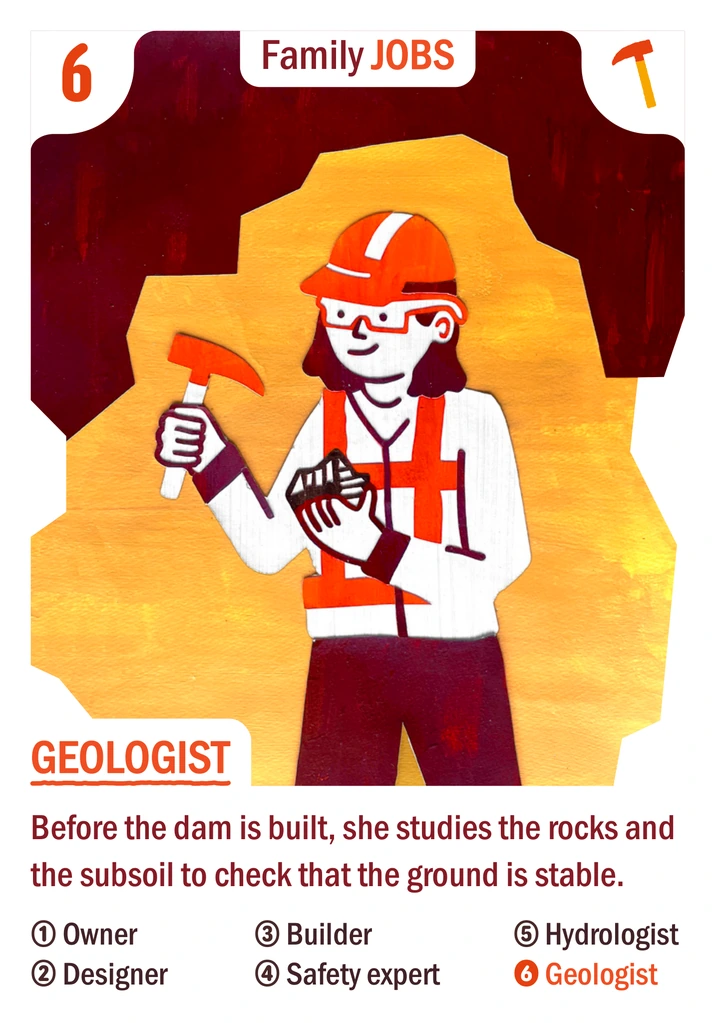
Jobs family · card no. 6
Geologist
Before the work starts, she studies the rocks and the ground to check that the terrain is solid enough.
Educational fact sheet
In brief
A dam is only as good as the ground it stands on! The geologist is the rock specialist. She explores the underground of the valley to be sure it will not give way, and will not let the water leak out.
How does it work?
From the very first studies, she:
- drills holes and brings up "cores": long cylinders of rock, to spot cracks and pockets of clay;
- tests watertightness: she injects pressurized water into the hole and watches whether it escapes;
- plans a "grout curtain": a curtain of liquid cement pushed into small cracks, to block the paths of the water.
Key facts
For an arch-shaped dam, the cliffs on each side must bear an enormous thrust: the geologist checks that they are strong enough.
Words to know
- Geologist: a person who studies rocks and the history of the Earth.
- Fault: a large natural crack in the rock.
Did you know? In 1959, the Malpasset dam (France) failed. It was not the concrete of the arch that gave way first: investigations pointed to the role of the rock it rested on and the water inside it. Since then, the rock and the underground water are studied much more carefully.
Going further
The choice of dam depends on several things: the shape of the valley, the strength and watertightness of the rock, the materials available, the floods to be passed and what the dam will be used for. A narrow valley with very solid rock may suit an arch dam well; a wider valley may suit an embankment dam better.
In FrenchGéologue