
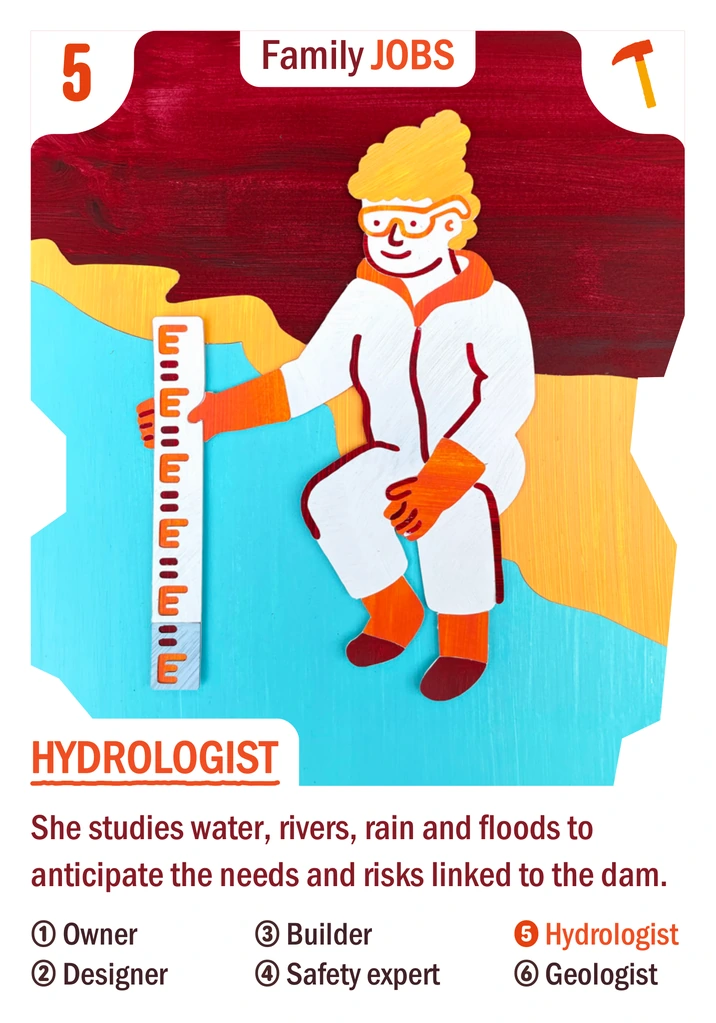
Jobs family · card no. 5
Hydrologist
She studies rain, rivers and floods to know how much water is coming, and when.
Educational fact sheet
In brief
The hydrologist is the scientist of the journey of water. She follows water from the rain or snow down to the river, to predict floods (too much water) and droughts (not enough).
How does it work?
To make predictions, she investigates:
- She measures: stations placed in rivers measure the flow (the amount of water passing by) and radars follow the rain.
- She compares with history: what was the biggest flood in 100 years? In 1,000 years? The dam must be able to cope with it.
- She looks to the future: climate change alters snow, droughts and some very heavy rains, in different ways depending on the region. She helps manage water well for the decades to come.
Key facts
Flow is measured in cubic meters per second (m³/s). One cubic meter is 1,000 liters, like 10 full bathtubs. During big storms in the Cévennes, the flow of a small river can increase enormously in just a few hours!
Words to know
- Watershed (drainage basin): the whole area where rain ends up in the same river.
- Evaporation: when the water of a lake flies off as vapor, thanks to the sun and wind.
Did you know? A large lake can lose several millimeters of water per day in summer, just through evaporation. Hydrologists measure that too!
Going further
Hydrologists do not make a single prediction of the future: they compare several models. Depending on the region, climate change can affect rain, snow, droughts and floods in different ways. In France, the Explore2 project studies these changes basin by basin, and also shows what scientists still understand poorly.
In FrenchHydrologue