
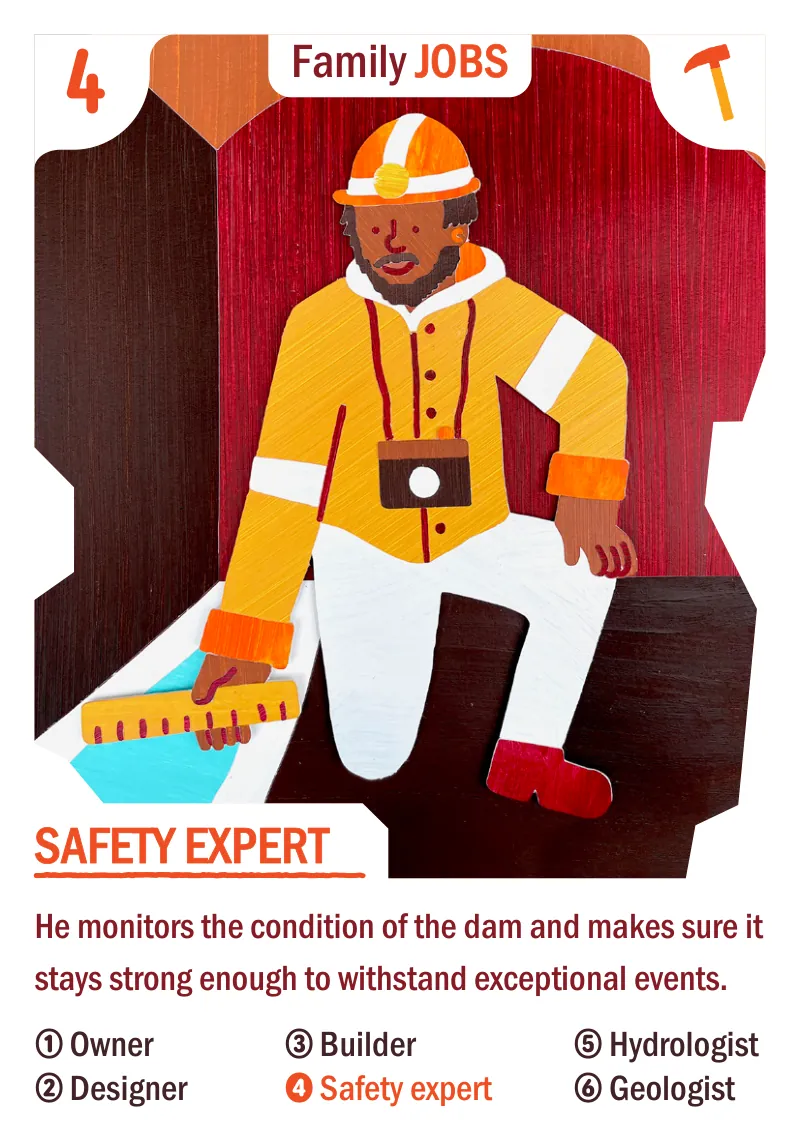
Jobs family · card no. 4
Safety expert
He monitors the dam's health, like a doctor, to spot the slightest problem very early.
Educational fact sheet
In brief
The safety expert is the dam's doctor. He listens to it, measures it and watches over it, day and night, to spot a tiny problem long before it becomes serious. This work is called monitoring (or auscultation).
How does it work?
A dam is not completely still: it moves a tiny bit! It expands (gets slightly bigger) when it is hot, and shrinks when it is cold. The expert:
- reads the measurements of a pendulum: a long wire hanging inside the dam, which shows how far the wall moves, to a tenth of a millimeter;
- looks at the pressure of the water seeping under the dam;
- sends divers or small underwater robots to inspect the wall on the lake side.
Key facts
The dam is monitored continuously and visited regularly. The more important it is, the more frequent the checks and reports.
Words to know
- Monitoring (auscultation): examining the dam with instruments, like a doctor with a stethoscope.
- Seepage: water that slowly slips into rock or soil.
Did you know? Among the clues that are watched is the water from the drains, small pipes that carry away seepage: its quantity and its clarity are tracked (is it clear or cloudy?). If it turns cloudy, perhaps soil is being carried away: it must be checked quickly!
Going further
- Monitoring reports: every year (class A), every 3 years (class B), every 5 years (class C).
- Instrument reports: every 2 years (class A), every 5 years (classes B and C).
- On top of that come the visits and rules specific to each dam.
- Clear drain water is not enough to conclude that the dam is safe: the flow, the turbidity (is the water cloudy?) and how they change over time are also followed.
In FrenchExpert sécurité