
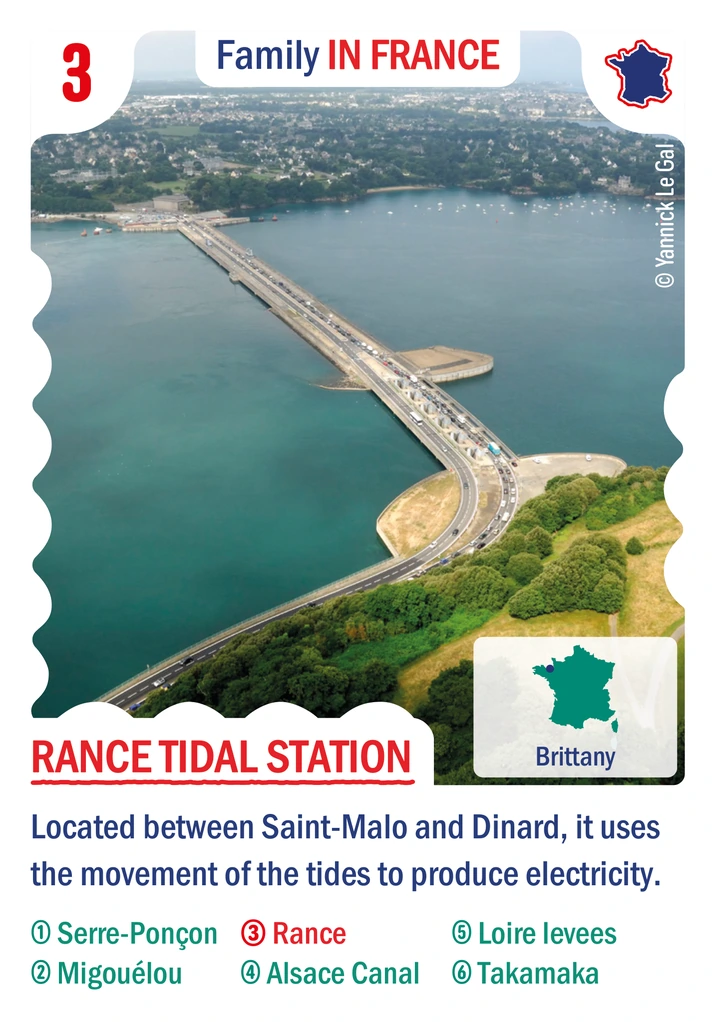
In France family · card no. 3 · Brittany (Ille-et-Vilaine)
Rance Tidal Power Station
Between Saint-Malo and Dinard, it uses the movement of the tides to produce electricity.
Educational fact sheet
In brief
Between Saint-Malo and Dinard, the Rance power station was the world's first tidal power station to produce electricity on a large scale. It uses the force of the tides, that is, the sea rising and falling, because of the pull of the Moon and the Sun.
How does it work?
In Saint-Malo, the sea rises and falls by an enormous height:
- Rising tide: the sea enters the estuary (the mouth of the river) through the dam's turbines.
- Falling tide: the dam holds the water back. When the sea has gone down far enough, the water is let out again, and it spins the turbines the other way.
- Very special turbines: 24 reversible "bulb" units, adapted to the tidal station, spin in both directions and can also pump water for extra help.
Key facts
- Maximum tide: up to 13.5 m difference between high tide and low tide.
- Power: 240 MW.
- Production: about 500 million kWh per year, enough to supply a city like Rennes.
- Inaugurated in 1966 by General de Gaulle.
Words to know
- Tide: the regular rise and fall of the sea, twice a day.
- Estuary: a large mouth where a river flows into the sea.
Did you know? The top of the dam is also a 4-lane road: thousands of cars use it every day to go from Dinard to Saint-Malo without taking the long way around!
Going further
Tides can be predicted very long in advance: we know the time and height of the tide for years to come, because they depend on the movement of the Moon and the Sun. That is not the case for wind or sunshine, which change with the weather. It is a rare advantage for a renewable energy.
In FrenchBarrage de la Rance
Photo credit : © Yannick Le Gal