
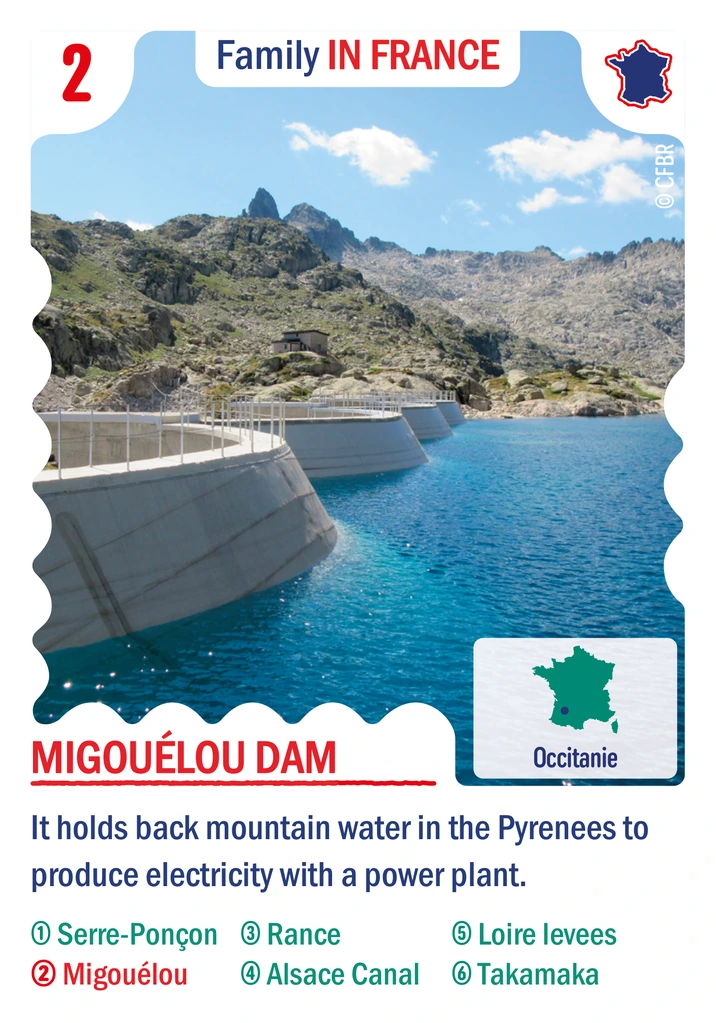
In France family · card no. 2 · Occitanie (Hautes-Pyrénées)
Migouélou Dam
It holds back the mountain water in the Pyrenees to produce electricity in power plants.
Educational fact sheet
In brief
At 2,278 meters altitude, in the Pyrenees National Park, Migouélou is a very original high-mountain dam. It is made of nine small concrete arches that follow the shape of the terrain.
How does it work?
Building this high was a challenge for the engineers. Since all the cement had to be carried up by cable car, they chose a light dam:
- 9 thin arches that lean on 8 buttresses (concrete pillars that serve as supports).
- The stored water feeds, through galleries dug in the rock, a series of seven power plants in the Azun valley.
Key facts
- Altitude: 2,278 m, in the high mountains.
- Height: 31 m. Length: 274 m.
- Built between 1956 and 1958, commissioned in 1959.
Words to know
- Buttress: a pillar that supports a wall from behind or from the side.
- Cable car: a cabin or bucket hung from a cable.
Did you know? No road goes up to the dam! Workers, machines (taken apart in pieces) and materials were carried up by cable car. Today, it generally takes several hours of hiking, depending on the route, to visit it.
Going further
A multiple-arch dam is not one big single arch: it is several thin arches, side by side, that each pass the push of the water on to buttresses, the concrete pillars. These pillars then send the push into the rock. This saves concrete, which was precious when everything had to be carried up by cable car.
In FrenchBarrage de Migouélou
Photo credit : © CFBR