
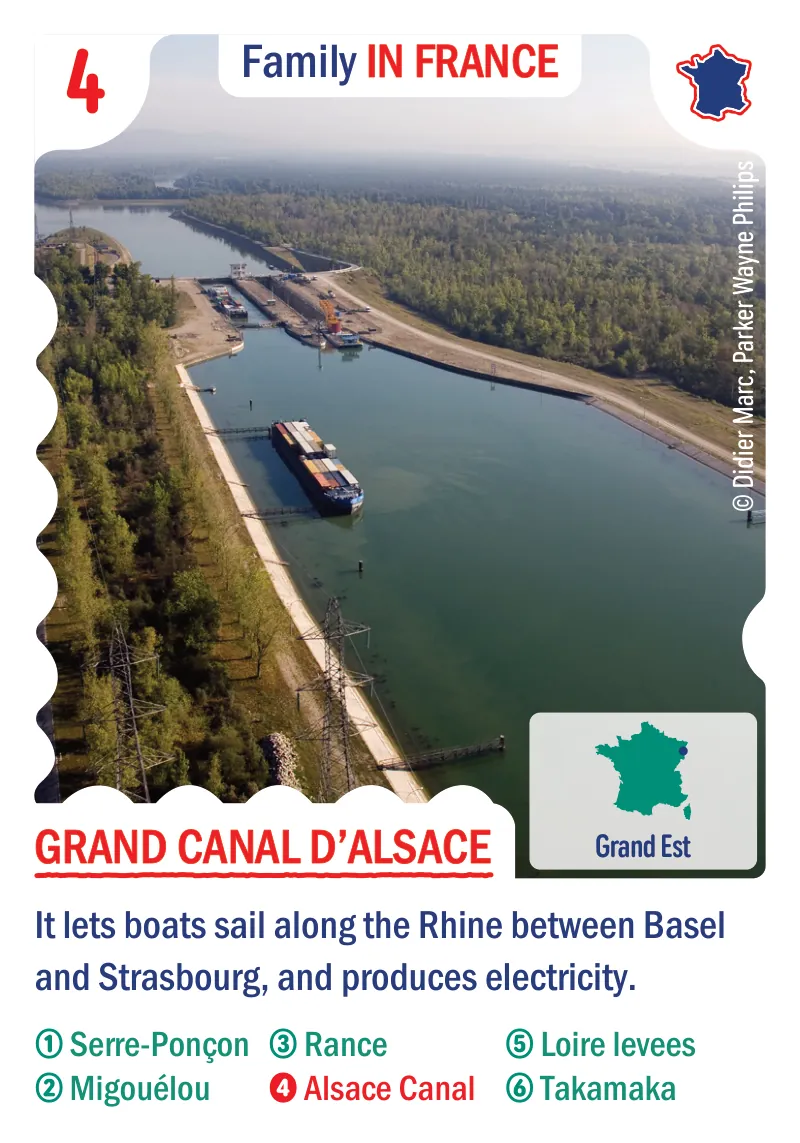
In France family · card no. 4 · Grand Est
Grand Canal d'Alsace
It makes it possible to sail on the Rhine between Basel and Strasbourg and to produce electricity.
Educational fact sheet
In brief
The Grand Canal d'Alsace is a canal about 50 kilometers long that runs alongside the Rhine, from Kembs to Vogelgrun. It is part of the waterway between Basel and Strasbourg. It is used both to let boats sail and to produce electricity.
How does it work?
In the 20th century, France decided to develop the Rhine, a river that was then wild:
- A dam (at Kembs) diverts part of the river into a very wide canal, up to 150 meters.
- Along the canal, the water passes through four lock-and-power stations: Kembs, Ottmarsheim, Fessenheim and Vogelgrun.
- Each site has a power plant and two big locks to let boats through without interruption.
Key facts
- Length: about 50 km, from Kembs to Vogelgrun.
- Production: about 4.5 billion kWh per year, with hardly any air pollution.
- Convoys of 3,000 tonnes can link Basel to Rotterdam.
Words to know
- Convoy: a group of barges (flat boats) pushed together by a single boat.
- Rhine: a great river that crosses Switzerland, France, Germany and the Netherlands.
Did you know? Fish passes have been installed on the Rhine to help migratory fish, like the Atlantic salmon, swim back up the river: they help restore the continuity of the Rhine.
Going further
Fish passes improve the continuity of the river, but they are not enough on their own. For a salmon to swim up the Rhine, it must get past all the obstacles on the river, from the sea to the rivers where it spawns. The return of migratory fish therefore depends on the whole river, not on a single dam.
In FrenchGrand Canal d’Alsace
Photo credit : © Didier Marc, Parker Wayne Philips