
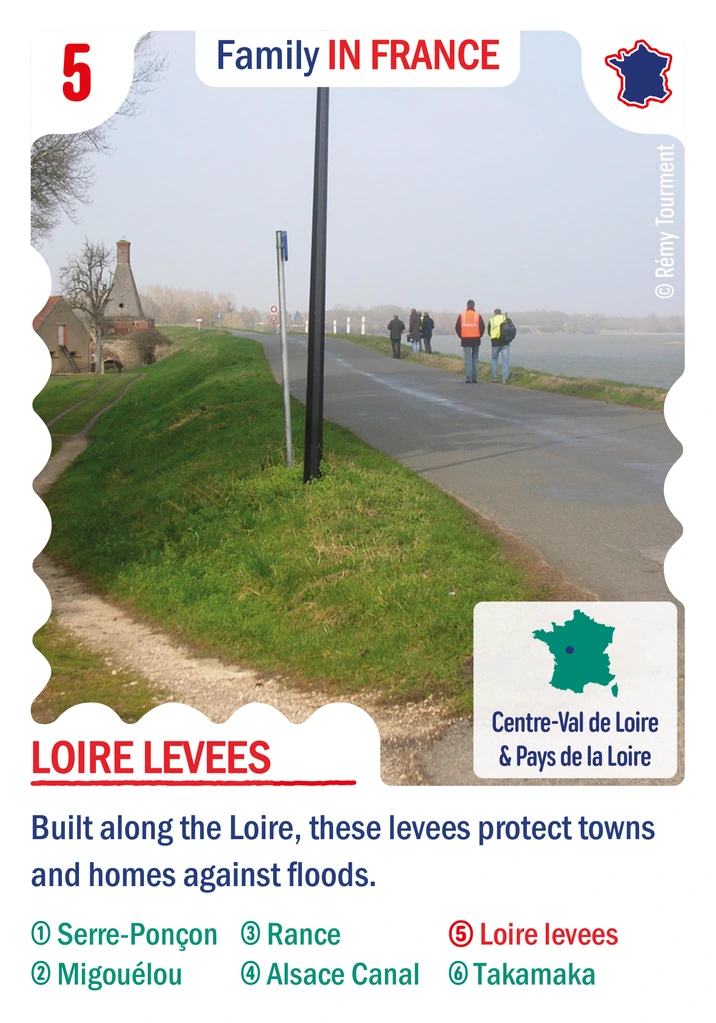
In France family · card no. 5 · Centre-Val de Loire & Pays de la Loire
Loire Levees
Built along the Loire, these levees protect towns and houses against floods.
Educational fact sheet
In brief
Over more than 600 kilometers, the Loire levees run along the "royal river". These levees, begun in the Middle Ages, protect hundreds of towns and villages against floods.
How does it work?
The protection of the Loire was built little by little:
- As early as the 12th century, the first earth levees were built, called turcies.
- In the 17th and 19th centuries, they were raised to more than 6 meters above the valley (the plain where the river can overflow).
- To keep the levee from failing in a town, spillways (déversoirs) were planned: lower spots, in masonry, where the water overflows on purpose toward fields, to save towns like Orléans, Blois or Tours.
Key facts
- 600 km of levees along the river.
- They protect residents, activities and territories (of the order of 300,000 people). The Loire Valley is also on the UNESCO World Heritage list for its cultural landscape (a list of places to protect for all humanity).
- Reference big floods: 1846, 1856 and 1866.
Words to know
- Levee: an earth bank that runs along a river.
- Spillway (déversoir): a place where water can overflow on purpose.
Did you know? The Loire levees are also used as a path: the famous cycle route "La Loire à Vélo" often follows them!
Going further
When a levee breaks, water can flood the plain behind it very quickly, because this plain is lower than the river. That is the great danger of these levees, and the reason they are monitored and maintained all the time. The spillways serve to choose where the water will go in case of a very big flood, rather than letting the levee give way where there are homes.
In FrenchLevées de la Loire
Photo credit : © Rémy Tourment