
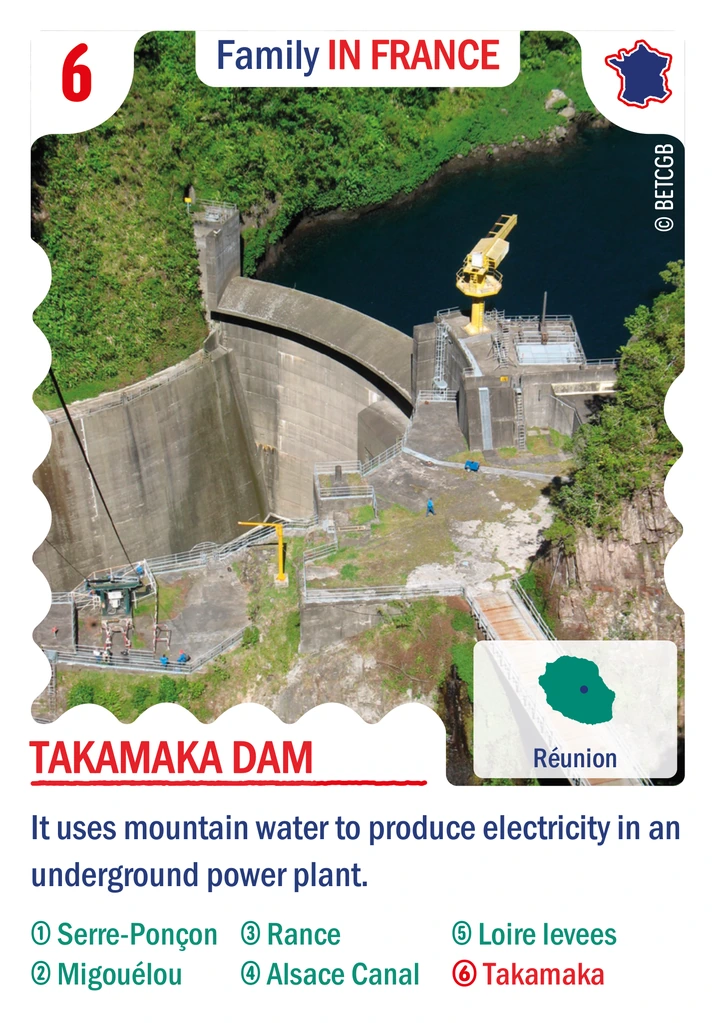
In France family · card no. 6 · La Réunion
Takamaka Dam
It uses mountain water to produce electricity in a power plant hidden underground.
Educational fact sheet
In brief
On the island of La Réunion, in the Indian Ocean, Takamaka is a spectacular hydroelectric site, at the bottom of a tropical canyon. Its power plant is hidden under 300 meters of volcanic rock, to withstand cyclones.
How does it work?
The valley of the Rivière des Marsouins is one of the rainiest in the world:
- Two small arch dams hold back the water: Takamaka I (15 m) and Takamaka II (29 m).
- During cyclones, the river can rise by 10 meters in 2 hours! To protect the turbines, the plant was dug underground, in volcanic rock (basalt).
- The water falls 270 meters down a vertical shaft, before reaching the turbines.
Key facts
- It rains up to 7 to 8 meters of water per year in the area!
- Power: about 44 MW for the two facilities together. Hydropower is one of the island's main sources of renewable electricity.
- Commissioned in 1968 (Takamaka I) and 1989 (Takamaka II).
Words to know
- Cyclone: a very violent tropical storm, with huge winds and rain.
- Basalt: a black rock formed by a volcano.
Did you know? The valley is so steep that no vehicle goes down into it! Equipment and EDF technicians get there by a cable car that flies over drops of several hundred meters.
Going further
In January 1966, Cyclone Denise dropped more than 1,800 millimeters of rain on La Réunion in 24 hours, a world record: almost three years of Paris rainfall in a single day! That is why the river can rise so fast, and why engineers put the power plant under the mountain, out of harm's way.
In FrenchBarrage de Takamaka
Photo credit : © BETCGB