
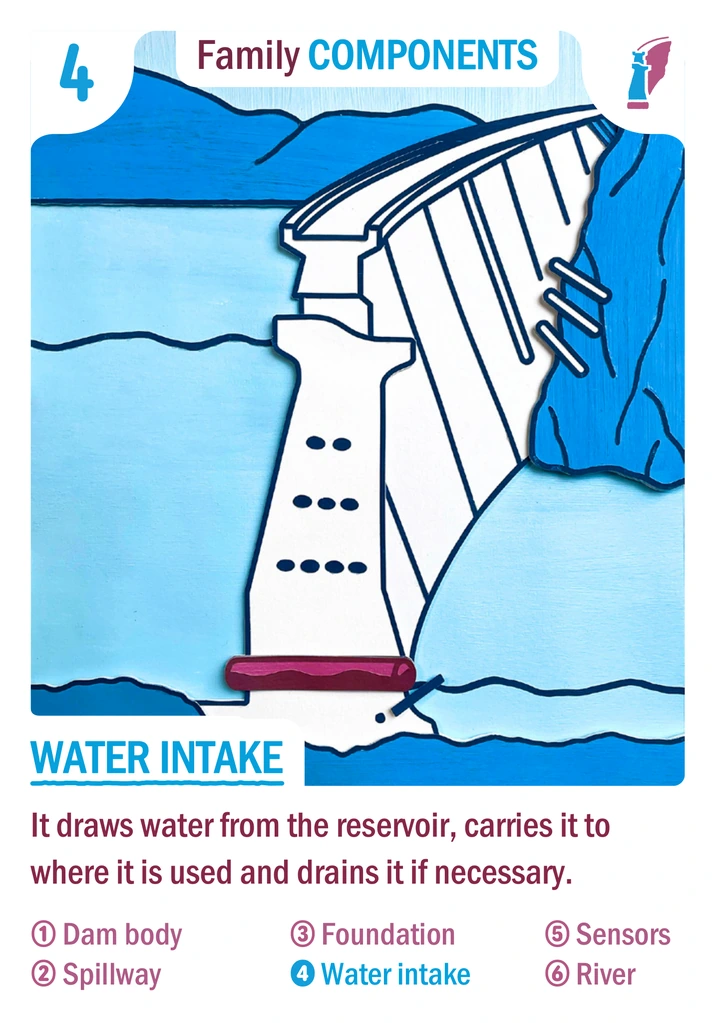
Components family · card no. 4
Water intake
It takes water from the lake and sends it where it is needed. The bottom outlet, next to it, makes it possible to lower the level of the lake.
Educational fact sheet
In brief
The water intake is the dam's tap. It is the big entrance through which water from the lake goes off to the turbines, the irrigation canals or the drinking-water plants.
How does it work?
It includes, among other things:
- The screens: big steel bars stop tree trunks, branches and debris, so that they do not damage the turbines.
- The head gate: a big safety door, which can cut off the water at once in case of a problem or for a repair.
Next to it, another structure is not used to take water: the bottom outlet, a huge pipe at the very bottom of the dam. It makes it possible to lower the level of the lake, even to empty it depending on the dam, and sometimes to flush out the silt (the sand and mud) piled up at the bottom.
Key facts
In a penstock, water can exceed 100 km/h as it reaches the turbine, the speed of a car on a country road!
Words to know
- Turbine: a wheel that spins under the push of water to make electricity.
- Sediments: sand, mud and small stones that the river carries.
Did you know? The bottom outlet is tested regularly. When its gate opens, the water gushes out with so much force that it would damage any protection: better not to stand in front of it!
Going further
- The water intake and the bottom outlet are two different structures. The intake feeds a pipe, a plant or a canal. The bottom outlet allows releases at low level, a partial or full emptying depending on the project, and sometimes the management of sediments.
In FrenchPrise d’eau