
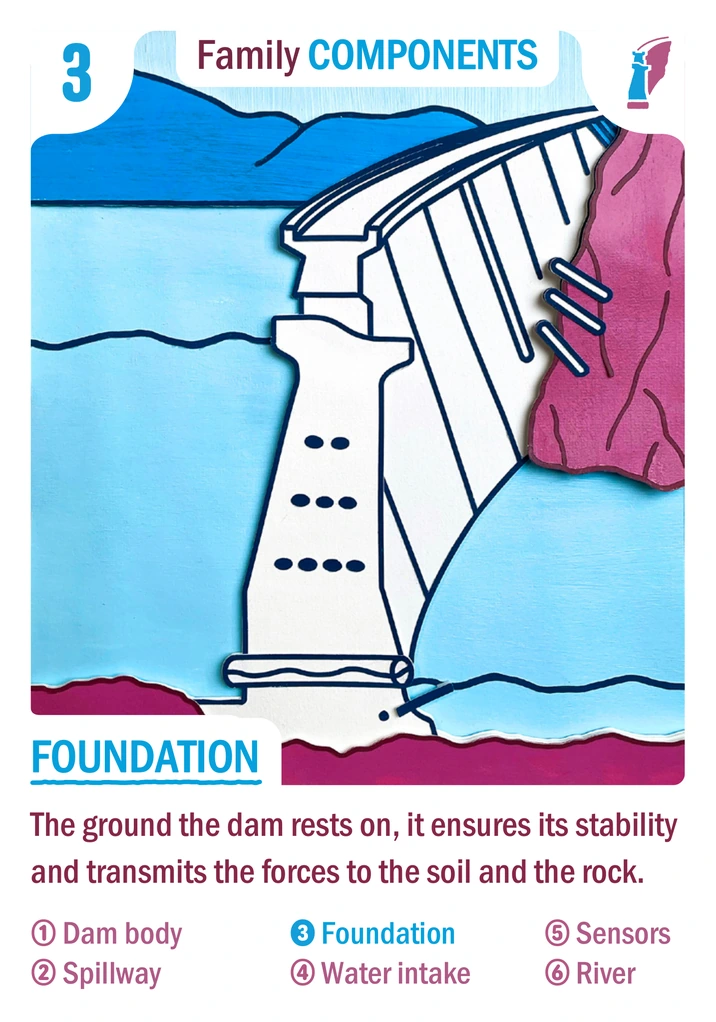
Components family · card no. 3
Foundation
The ground the dam rests on: it holds it up and passes its weight on to the rock.
Educational fact sheet
In brief
The foundation is the dam's hidden root. Sunk into the riverbed and into the sides of the mountain, it bears the weight of the dam and the push of the lake.
How does it work?
The great enemy is not only the water you can see, it is the water that sneaks under the dam:
- Uplift pressure: this water pushes upward and would like to lift the dam, like a cork!
- The grout curtain: thousands of holes are drilled and liquid cement is injected to block all the cracks in the rock, down to several tens of meters deep, depending on the rock of the site.
- The drains: just behind, small pipes collect the water that gets through anyway, to lower the pressure safely.
Key facts
Depending on the site, people sometimes dig several tens of meters under the riverbed to find solid rock.
Words to know
- Foundation: a base sunk into the ground that supports a building or a dam.
- Drain: a small pipe that carries water away.
Did you know? At Serre-Ponçon, the bedrock was under more than 100 meters of sand and gravel! Engineers built a deep watertight cut-off wall in these alluvial deposits (the sand and gravel laid down by the river) to limit leaks under the dam.
Going further
Water passing under a dam does not only leak: it presses upward and "lightens" the dam, a bit like a boat that floats. A lighter dam rubs less on its ground and resists sliding less well. That is why engineers install drains and constantly measure the water pressure in the foundation.
In FrenchFondation