
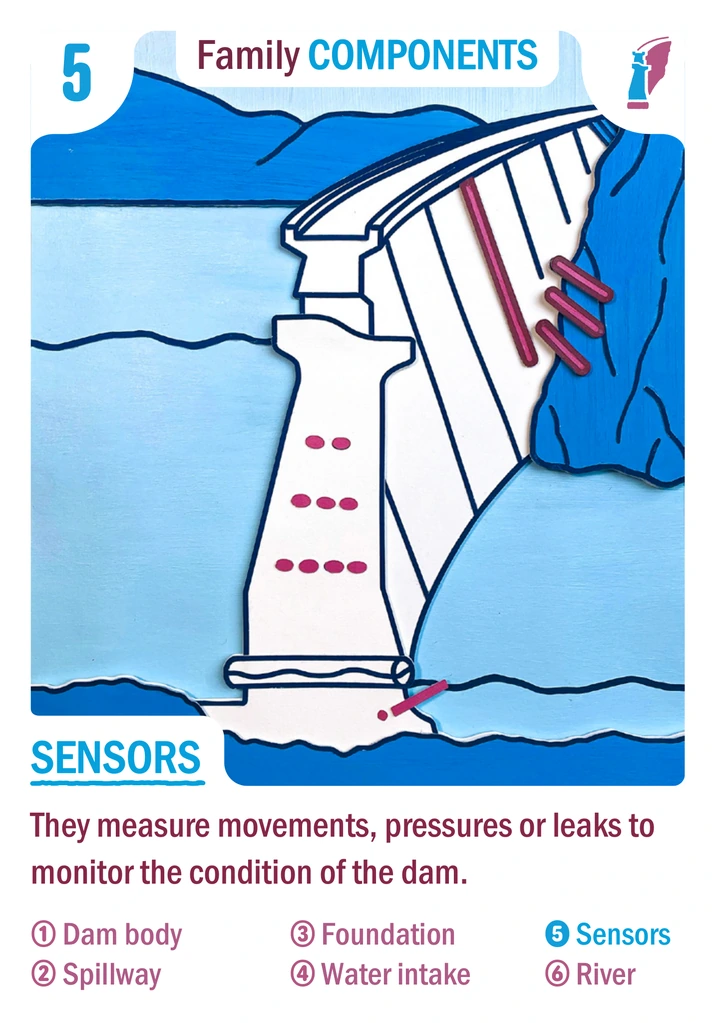
Components family · card no. 5
Sensors
They measure movements, water pressure and leaks to watch over the dam's health.
Educational fact sheet
In brief
Sensors are the senses of the dam. Hidden in the concrete and the rock, hundreds of instruments measure day and night the slightest movements, the water pressure and the vibrations of the ground.
How does it work?
Engineers use plenty of surprising instruments:
- Pendulums: a long steel wire hung in a vertical shaft, sometimes tens of meters long. With great precision (of the order of a tenth or a hundredth of a millimeter), it shows how far the dam moves.
- Piezometers: they measure the water pressure inside the dam and in the ground.
- Leak-measuring boxes: small V-shaped boxes measure the flow of water running out of the drains.
- Laser sightings and GPS: they measure the movements of the top of the dam, to check that they stay normal.
Key facts
A 100-meter-high arch dam moves forward by a few millimeters to a few centimeters when the lake fills, then comes back when it empties. We say it "breathes"!
Words to know
- Sensor: a device that measures something (a pressure, a movement, a temperature...).
- Optical fiber: a very thin wire that carries light.
Did you know? In some recent dams, kilometers of optical fibers have been buried in the concrete. They measure temperature and deformation all along the dam.
Going further
What matters most to the engineer is how a measurement changes over time. A single value says little: a displacement of a few millimeters can be perfectly normal in summer and worrying if it shows up in the middle of winter. So each measurement is compared with those of previous years, to spot a slow drift before it becomes a problem.
In FrenchCapteurs