
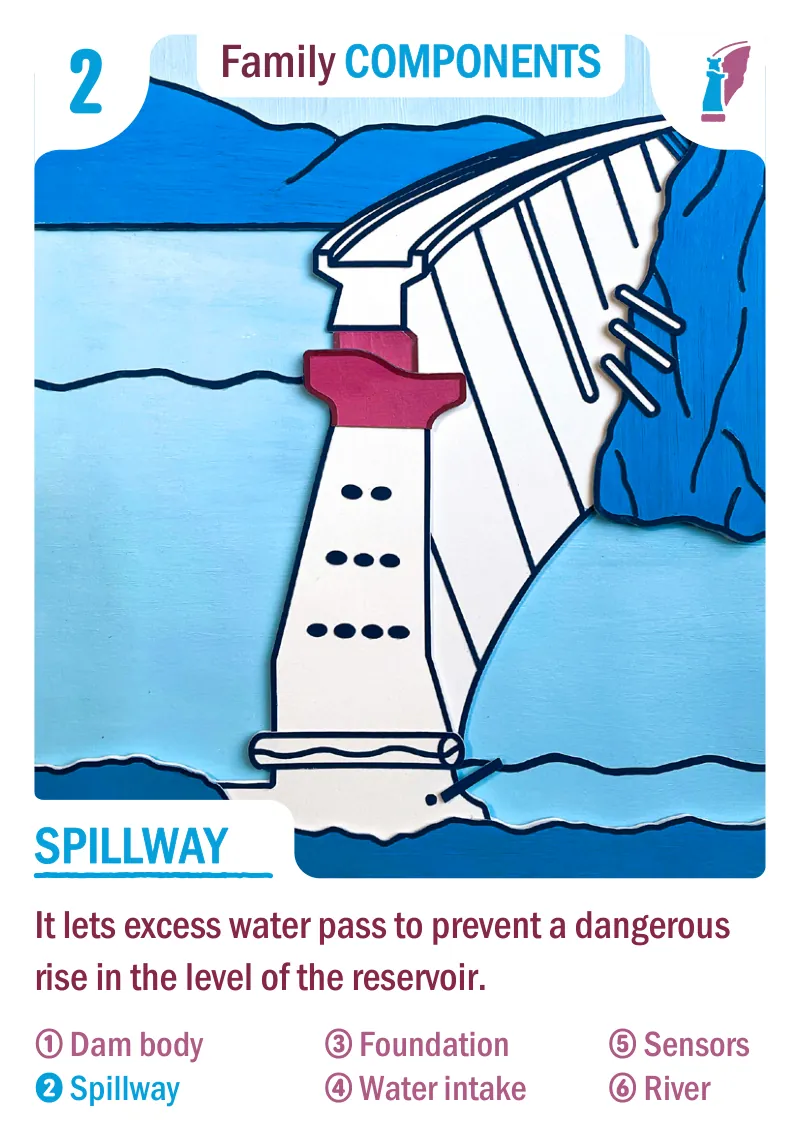
Components family · card no. 2
Spillway
It lets the extra water through so that the lake does not spill over the top of the dam.
Educational fact sheet
In brief
The spillway is the dam's safety valve, like the overflow of a bathtub. When a very big flood arrives, it lets the extra water go, to keep it from passing over the top of the dam.
How does it work?
Water falling from very high is very powerful. The spillway guides it in three steps:
- The sill: the water spills over at the right spot, either on its own when it reaches a precise level (with no moving parts, which avoids some breakdowns), or by opening big gates called sluice gates.
- The chute: a huge concrete slide that brings the water down gently.
- The energy dissipator: at the bottom, the water is thrown by a ski-jump bucket in big sprays, or falls into a basin, to lose its strength.
Key facts
The spillway of Itaipu (Brazil and Paraguay) can pass about 62,000 cubic meters per second, about 40 times the average flow of the Iguazu Falls, a huge waterfall very close by.
Words to know
- Flood: when the river swells very strongly.
- Sluice gate: a big door that opens or closes to control the water.
Did you know? Some spillways are shaped like a giant funnel (they are called "morning glory" spillways). The water swirls there, plunges into a big hole, then comes out lower down, behind the dam.
Going further
There are two main families of spillways. The free sill works with no motor and no control: as soon as the lake rises above a precise level, the water goes over, which avoids breakdowns. The gated spillway has big gates that can be opened on demand to control the level of the lake, but it needs energy and upkeep. Many dams combine both.
In FrenchÉvacuateur