
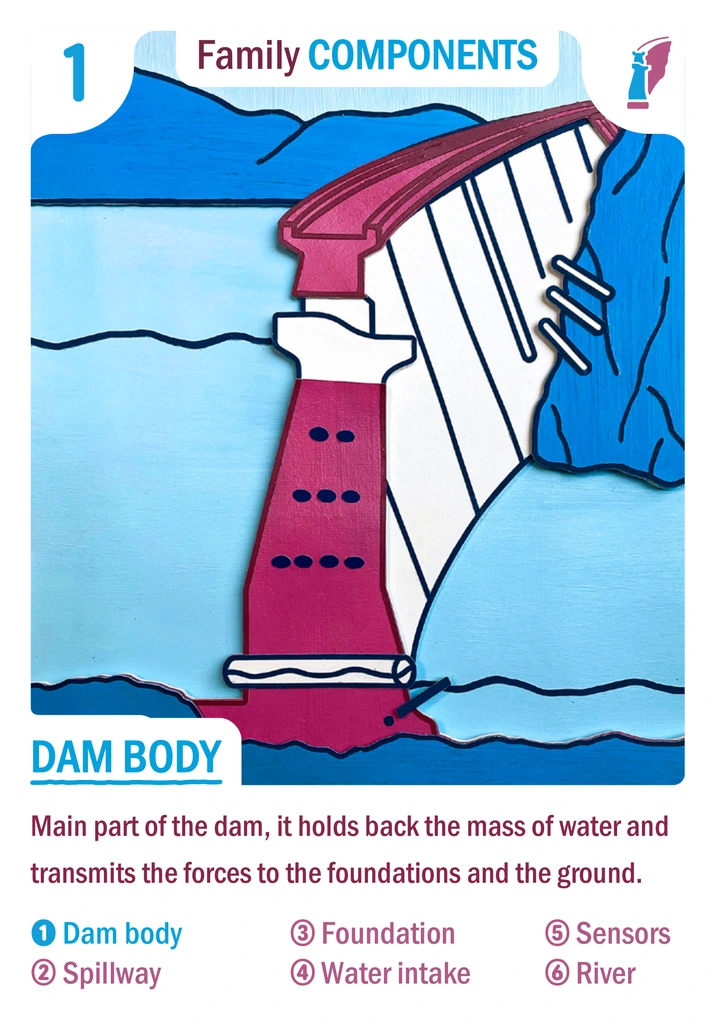
Components family · card no. 1
Dam body
It is the big wall of the dam: it holds back all the water of the lake and passes the push on to the ground or the cliffs.
Educational fact sheet
In brief
The body is the main wall of the dam, the one you see across the valley. Whether it is made of concrete or of earth and stones, its job is simple: to hold firm against the enormous push of the water.
How does it work?
The deeper you go in a lake, the harder the water pushes (you have felt it in your ears at the bottom of a swimming pool!). So the dam body is built to:
- be wider at the bottom than at the top (as many dams are), where the push is strongest;
- not let water through: thanks to the mass of the concrete, or to a clay core (a very sticky soil) or to a special lining on the lake side;
- be built in blocks: large concrete dams are generally built in blocks and successive layers, because concrete expands and shrinks with temperature. Flexible joints between the blocks keep everything watertight.
Key facts
The push of the water on a large dam can reach several million tonnes.
Words to know
- Watertight: that does not let water through.
- Clay: a fine, sticky soil that blocks water.
Did you know? Inside large concrete dams there are lit galleries, like submarine corridors. Technicians walk through them to inspect the dam from the inside!
Going further
- A gravity dam takes the push mostly through its weight and its foundation. An arch dam passes most of it on to its rocky abutments (the cliffs).
- The "wider at the bottom" shape does not apply to all types of dams.
In FrenchCorps