
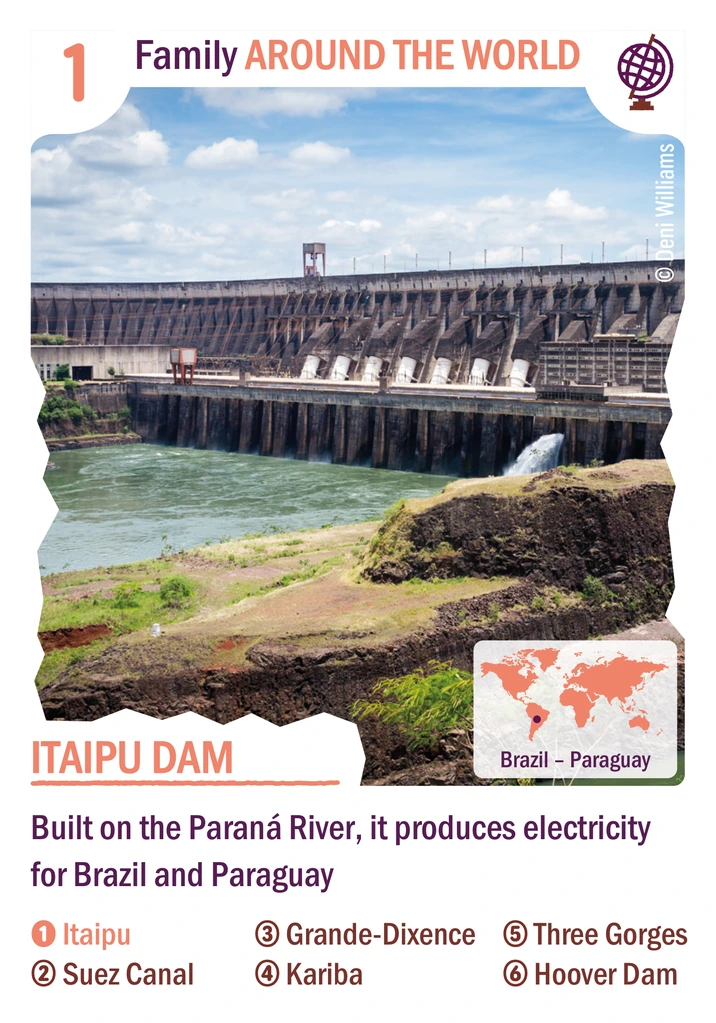
Around the world family · card no. 1 · Brazil and Paraguay
Itaipu Dam
Built on the Paraná River, it produces electricity for Brazil and Paraguay, which share it.
Educational fact sheet
In brief
Itaipu is built on the Paraná River, on the border between Brazil and Paraguay, two countries that built it together. It is one of the biggest electricity producers in the world, thanks to its 20 enormous turbines.
How does it work?
Itaipu combines a big concrete dam with long earth embankments on the sides:
- 20 giant pipes 10.5 meters across (a double-decker bus would fit through!) send the water onto turbines that weigh nearly 300 tonnes each.
- Two electrical "languages": Paraguay uses current at 50 hertz and Brazil at 60 hertz (the hertz measures how fast the current "goes back and forth"). So half of the turbines spin one way, the other half the other way.
Key facts
- Power: 14,000 MW.
- In 2016, Itaipu produced 103 billion kWh: that year, this covered about 85% of Paraguay's electricity and 15% of Brazil's (these shares change from one year to the next).
- Length: 7.9 km. Height: 196 m.
Words to know
- kWh (kilowatt-hour): an amount of electricity. An electric oven switched on for 1 hour uses about 2.
- Binational: belonging to two countries.
Did you know? The dam is very close to the Iguazu Falls, one of the biggest waterfalls in the world. In case of a very big flood, its spillway can let through about 40 times the average flow of these falls!
Going further
Itaipu is run by a joint company owned in equal parts by Brazil and Paraguay. The electricity produced is shared in two equal halves. Since Paraguay uses less than its half, it sells the rest to Brazil: that is how the dam supplies a lot of electricity to both countries.
In FrenchBarrage d'Itaipu
Photo credit : © Deni Williams