
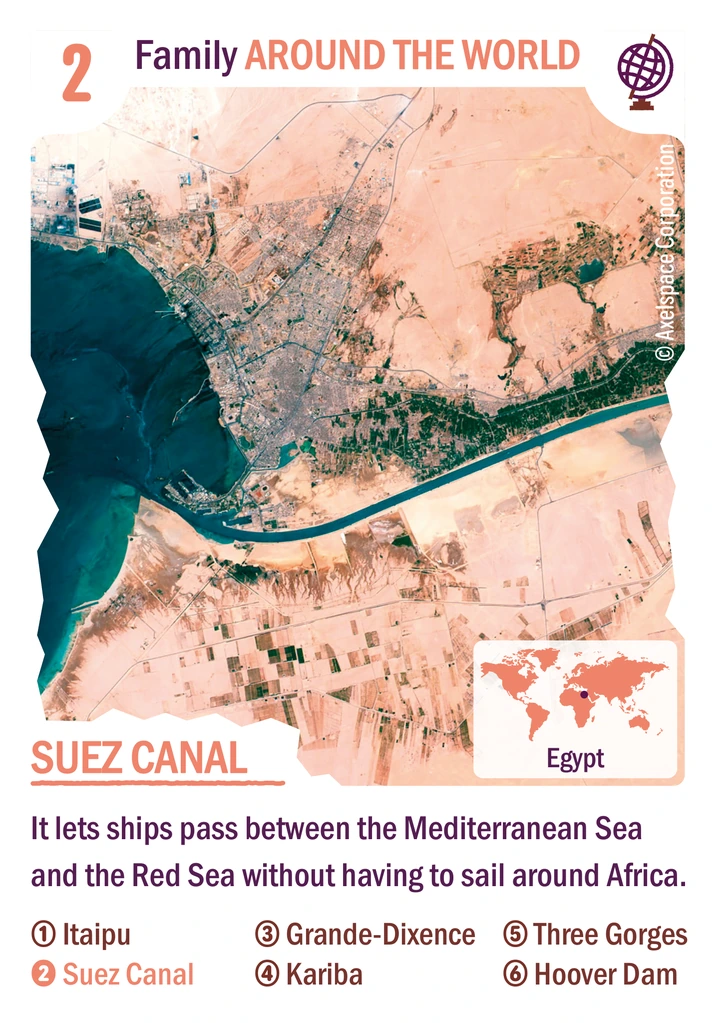
Around the world family · card no. 2 · Egypt
Suez Canal
It lets ships go from the Mediterranean to the Red Sea without sailing all the way around Africa.
Educational fact sheet
In brief
Dug through the desert, between Africa and Asia, the Suez Canal is a giant shortcut between the Mediterranean Sea and the Red Sea. Without it, ships would have to sail around Africa: more than 7,000 km extra!
How does it work?
The Suez Canal has a special feature: it has no locks at all!
- The Mediterranean and the Red Sea are almost at the same level. Seawater therefore flows freely from one end to the other, like in a big trench filled with water.
- It is a dug and dredged channel (cleared of the sand that builds up in it) in sand and clay. It passes through a large lake, where ships can pass each other.
Key facts
- Length: 193 km, from Port Said to Suez.
- Inaugurated in a big ceremony on 17 November 1869, after 10 years of work. The project was led by the Frenchman Ferdinand de Lesseps.
- About one tenth of the world's maritime trade passes through it.
Words to know
- Lock: a boat elevator that makes up for a difference in water level.
- Container ship: a very large ship that carries giant metal boxes.
Did you know? In March 2021, a huge 400-meter container ship, the Ever Given, ended up across the canal because of the wind. It stayed stuck for six days, and more than 400 ships had to wait!
Going further
No locks, but two permanent challenges. The first is sand: the desert wind keeps depositing it, and the canal must be dredged continuously to keep its depth. The second is traffic: over a large part of the canal there is only one lane, so ships travel in convoys and pass each other in widened areas, like the Great Bitter Lake.
In FrenchCanal de Suez
Photo credit : © Axelspace Corporation