
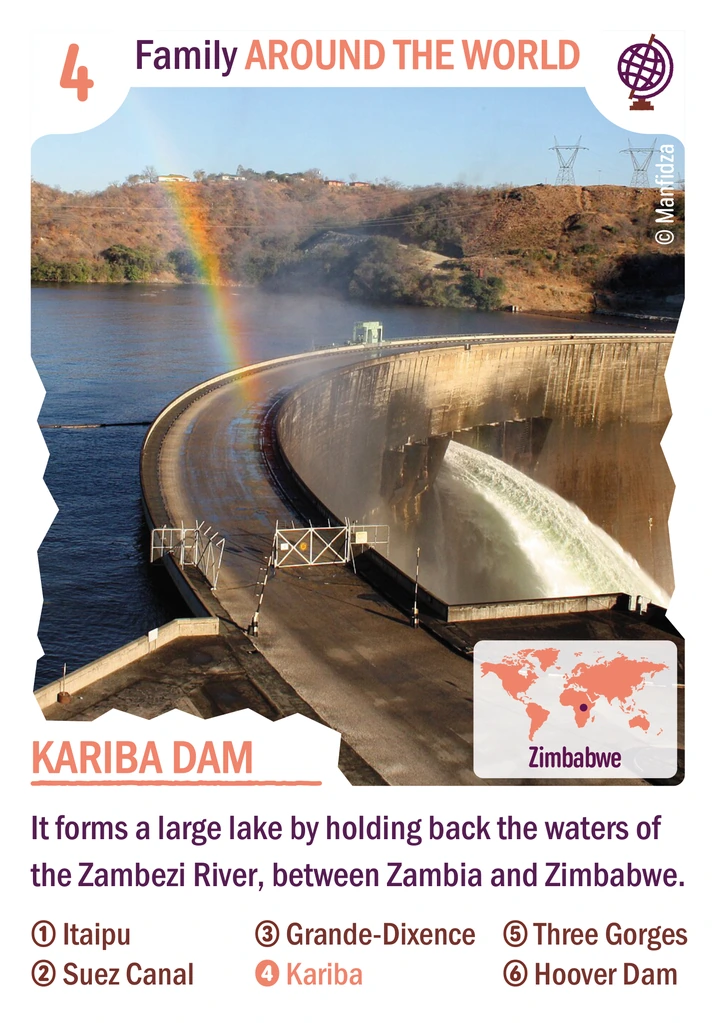
Around the world family · card no. 4 · Zambia and Zimbabwe
Kariba Dam
It forms an immense lake by holding back the Zambezi River, between Zambia and Zimbabwe.
Educational fact sheet
In brief
Built in the 1950s on the Zambezi River, in Africa, Kariba gave birth to one of the largest artificial lakes in the world, often cited among the top by volume of water. The dam is a big arch, designed by the engineers Coyne and Bellier, under the impetus of André Coyne.
How does it work?
Kariba is an arch dam: it is curved, and the push of the river is sent onto the rocky walls of the gorge.
- Two power plants, one on each side of the river (one in Zambia, one in Zimbabwe), supply the region and its copper mines.
Key facts
- The lake can hold about 180 billion cubic meters of water: about four times more than the lake of the Three Gorges!
- Height: 128 m. Length: 579 m.
- The lake covers more than 5,500 km², about the size of a French department.
Words to know
- Zambezi: a great river of southern Africa, famous for the Victoria Falls.
- Mine: a place where ores, like copper, are extracted.
Did you know? During the construction, the river had some very big floods. In the tradition of the Tonga, a people living along the river, it was the anger of Nyaminyami, the river's serpent god. The engineers held on and finished the dam!
Going further
Kariba is run jointly by two neighboring countries separated by the river: Zambia and Zimbabwe. A joint authority between the two countries manages the lake and the dam. Each country has its own power plant, on its own bank of the Zambezi.
In FrenchBarrage Kariba
Photo credit : © Manfidza